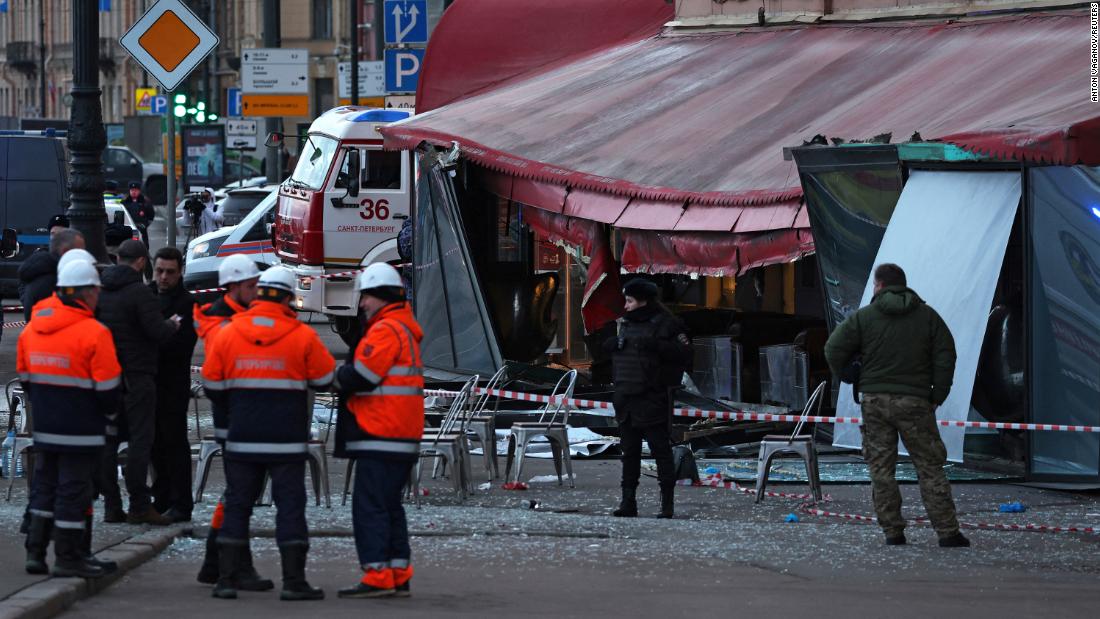
A devastating explosion rocked a cafe in central St. Petersburg, Russia, on Sunday, in an attack that killed influential military blogger Vladlen Tatarsky and injured at least 30 others, according to Russian authorities. The incident, which Russia's Investigative Committee has classified as a terrorist act, has shocked the nationalist community and highlighted the deep tensions within the country against the backdrop of the war in Ukraine.
The attack took place at the Street Food Bar No. 1 cafe, located on the central Universitetskaya Naberezhnaya street along the Neva River. Tatarsky, whose real name was Maxim Fomin, was participating in an event organized by the 'Cyber Front Z' group, an organization that supports Russia's military offensive in Ukraine. Initial reports from Russian news agencies suggest the explosive device was hidden inside a statuette presented to the blogger as a gift during a supposed meeting with followers. Videos circulating on social media, which CNN has geolocated and verified, show the precise moment of the detonation: a powerful blast that shatters the cafe's interior, sends debris flying into the street, and leaves those present in a state of shock.
Vladlen Tatarsky, 40, was one of the most prominent figures in Russia's militaristic blogosphere. With over 560,000 followers on his Telegram channel, 'Vladlen Tatarsky', his analysis, often critical of the Russian Defense Ministry's conduct but firmly pro-war, commanded a wide audience. He gained notoriety after filming himself in the Kremlin in September 2022 during a ceremony annexing Ukrainian territories, where he stated: "We will defeat everyone, we will kill everyone, we will rob everyone as needed." His profile grew enormously during the conflict, representing an influential voice within the segment of 'patriotic bloggers' who demand a harder and more effective war.
Russia's Investigative Committee, the country's main investigative body, immediately opened a terrorism case. Spokesperson Svetlana Petrenko stated that "it was established that the explosive was detonated from inside the figurine given to Tatarsky." Security forces have launched a manhunt for the suspected perpetrator, identified by Russian media as Darya Trepova, a 26-year-old woman from St. Petersburg who allegedly delivered the statuette. She was reportedly detained hours after the attack. While no official claim of responsibility has been made, the shadow of possible internal vendettas or operations by Ukrainian services looms over the investigation. Mykhailo Podolyak, an advisor to the Ukrainian President's Office, denied any direct involvement from Kyiv, suggesting instead that this was a case of "internal strife" and "domestic terrorism" in Russia.
The impact of this assassination extends beyond personal tragedy. It exposes the vulnerability of public figures in Russia and marks an escalation in targeted attacks within Russian territory, reminiscent of the bombing that killed Darya Dugina, the daughter of an ultra-nationalist ideologue, last August. For the Russian military and security establishment, it is a direct blow to a segment of public opinion that, although critical, supported the war. It fosters a climate of paranoia and could trigger even greater repression against any dissent or activity deemed suspicious. Furthermore, it silences one of the voices that, from a nationalist flank, was pressuring for greater military efficacy, potentially altering the fragile narrative balance within Russia.
In conclusion, the explosion at the St. Petersburg cafe is not an isolated act of violence. It is a severe symptom of the contradictions and conflicts that the war in Ukraine has unleashed within Russian society. The elimination of Vladlen Tatarsky, a key media actor in the ecosystem of war propaganda and analysis, leaves a void and sends a chilling message about the risks of polarization. The incident will likely lead to a high-profile investigation and official rhetoric blaming external forces, but it also raises uncomfortable questions about internal security and the internecine wars between different factions within the broad spectrum that supports the conflict. The shadow of violence has once again reached the heart of a major Russian city.