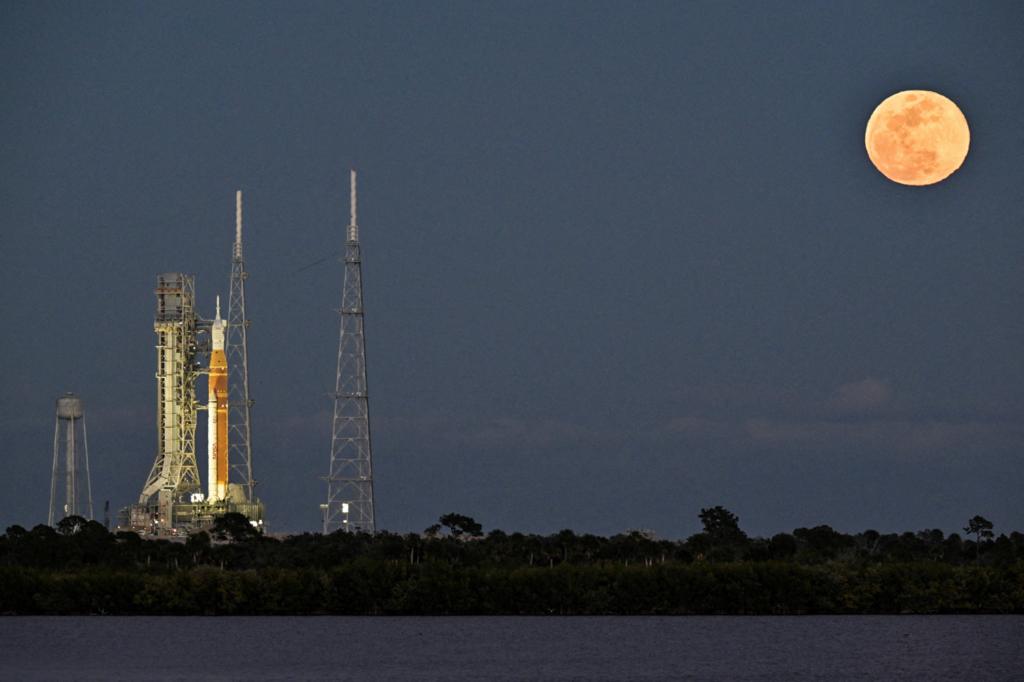
The National Aeronautics and Space Administration (NASA) has set a new target launch window for the Artemis II mission, the first crewed mission bound for the Moon in over half a century. According to official announcements, the U.S. space agency is aiming for early March to send four astronauts on a historic journey around our natural satellite. This flight, which will not include a lunar landing, represents a monumental step in the Artemis program, whose ultimate goal is to establish a sustainable human presence on the Moon and, eventually, pave the way for missions to Mars.
The Artemis II mission will be the first crewed flight test of the Space Launch System (SLS) rocket and the Orion capsule, which proved their capability in the uncrewed Artemis I mission in late 2022. The crew, consisting of astronauts Reid Wiseman, Victor Glover, Christina Koch, and Jeremy Hansen, will spend approximately ten days in space. Their trajectory will take them on a distant retrograde orbit around the Moon, a path that will take them farther from Earth than any humans in history, surpassing the record set by the Apollo 13 mission. This flight is critical for testing life support systems, communications, and navigation in the deep space environment with a crew on board.
The context of this announcement is framed within a renewed space race, where several nations and private companies have declared lunar ambitions. NASA's Artemis program seeks not only to return to the Moon but to do so in a more inclusive and sustainable way, with plans for a lunar space station (Gateway) and surface bases. "We are building on the legacy of Apollo, but this time we're going to stay," a senior NASA administrator recently stated. The early March launch window is contingent upon the successful completion of data analysis from Artemis I, reviews of the spacecraft's systems, and weather conditions at the Kennedy Space Center in Florida.
Relevant data underscores the complexity of the endeavor. The SLS rocket, standing over 322 feet tall, is the most powerful ever built. The Orion capsule has been designed to withstand the rigorous conditions of deep space, including radiation. The mission will collect invaluable data on the effects of prolonged exposure to the radiation environment beyond the protection of Earth's magnetic field, information crucial for future long-duration missions. Additionally, new spacesuits and operational protocols will be tested.
The impact of a successful mission would be profound. It would revitalize human space exploration globally, demonstrating the feasibility of international collaborations, as the mission includes an astronaut from the Canadian Space Agency. It would also serve as a catalyst for the commercial space industry and solidify United States leadership in the space domain. However, challenges persist, from inherent technical risks to the ever-present factor of congressional budget constraints.
In conclusion, NASA's target of launching Artemis II in early March marks a critical milestone on humanity's path back to the Moon. It is a testament to engineering perseverance and exploratory ambition. If successful, this mission will not only make history by carrying the first woman and first person of color to lunar orbit but will also ignite the spark for the next great leap in solar system exploration, bringing us one step closer to the vision of making humanity an interplanetary species.