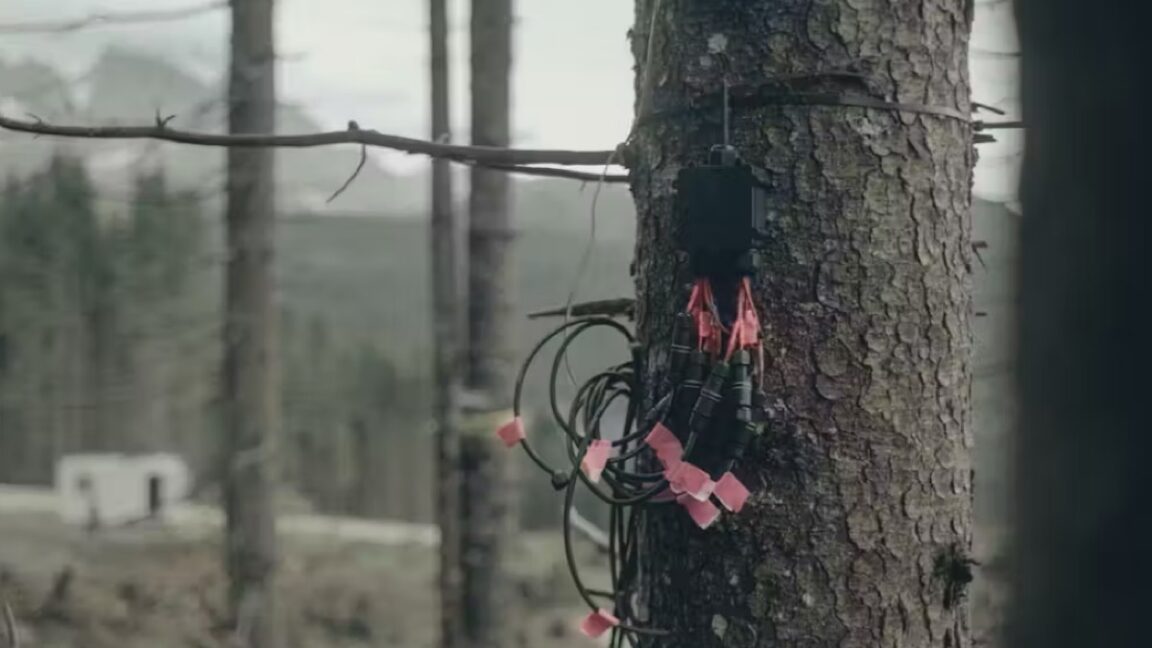
A study published in early 2025 claiming to have detected trees exhibiting a 'conscious physiological response' to solar eclipses has been subjected to a devastating critique by an international consortium of biologists and physicists. The original research, led by a fringe group and published in a journal of dubious prestige, argued that high-precision sensors had recorded 'anomalous vibration patterns' and 'changes in electrical conductivity' in the xylem of several tree species minutes before and during a total solar eclipse in 2024. The original authors interpreted this data as evidence of a form of 'environmental perception' unexplained by conventional biology, an argument quickly picked up by sensationalist media and pseudoscientific circles.
However, the new critique, published this week in the prestigious journal 'Nature Ecology & Evolution' under the title 'Debunking Pseudoscience in Plant Physiology,' methodically dismantles each of the claims of the controversial paper. The review team, composed of experts in plant physiology, biophysics, and signal analysis, demonstrates that the recorded 'anomalous patterns' are entirely consistent with predictable microclimatic fluctuations that occur during an eclipse. 'What the original authors attributed to arboreal perception is, in fact, the passive response of plant tissues to rapid changes in ambient temperature, relative humidity, and atmospheric pressure,' explains Dr. Elena Vargas, a plant physiologist at the University of Barcelona and co-author of the critique. 'Trees do not 'sense' the eclipse; they simply react physically, as any biological material would, to an abrupt environmental change.'
The detailed analysis reveals serious methodological flaws in the 2025 study. These include the lack of an adequate control group (trees monitored under similar conditions but without an eclipse), incorrect calibration of water potential sensors, and, most seriously, a data interpretation biased by unscientific presuppositions. The critics conducted an experimental replica during the latest annular eclipse, rigorously controlling environmental variables, and found no signal deviating from established physio-biological models. 'The study's core claim lacks a plausible biological mechanism,' states Professor Aris Thompson, a biophysicist at Stanford. 'It invokes a sort of tree 'consciousness' without defining it, without measuring it directly, and without proposing a theoretical framework to support it. It is, in essence, magic disguised as technical jargon.'
The impact of this controversy transcends academic debate. The original publication had been instrumentalized by movements promoting concepts such as 'plant neurobiology' or 'forest consciousness,' ideas that, while poetic, lack solid empirical backing according to mainstream science. The swift and forceful response from the scientific community seeks to establish a sanitary cordon against what many see as a growing 'pseudoscientific infiltration' in biological literature. 'This case represents a textbook example of how lax methodology, combined with a desire to find extraordinary results, can lead to absurd conclusions,' warns the editorial accompanying the critique in 'Nature.' 'Peer review and critical scrutiny remain the indispensable pillars for preserving the integrity of science.'
In conclusion, the episode serves as a crucial reminder about the standards of evidence in scientific research. While fascination with plant intelligence and sentience continues to inspire legitimate lines of inquiry—such as complex chemical signaling or root communication systems—it is vital to distinguish between testable hypotheses and speculative narratives. The critique not only debunks a specific claim but reinforces the need for rigor, skepticism, and reproducibility as antidotes to the degradation of scientific discourse. The mystery of plant life remains profound, but its exploration must advance with the tools of science, not with the wishes of imagination.