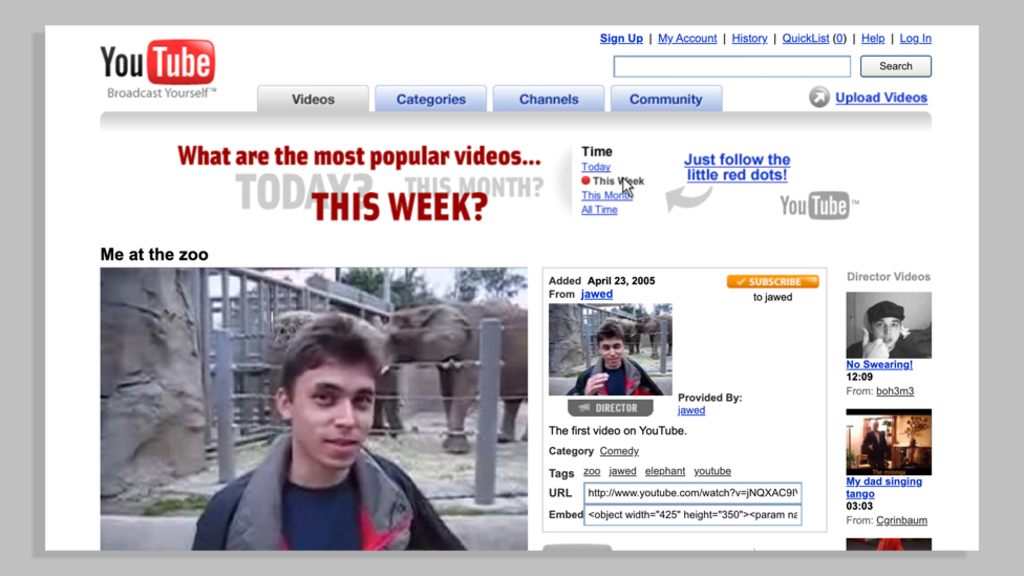
London's Victoria and Albert Museum (V&A), one of the world's leading cultural institutions, has taken a historic step by acquiring and displaying the first video ever uploaded to YouTube and the original watch page where it was viewed. This act not only recognizes a specific digital artifact but enshrines a foundational moment of 21st-century internet culture. The piece, titled "Me at the zoo," was uploaded by the site's co-founder, Jawed Karim, on April 23, 2005, and features a brief conversation in front of the elephants at the San Diego Zoo. Beyond its simplicity, the video symbolizes the birth of a platform that would revolutionize the creation, distribution, and consumption of audiovisual content on a global scale.
The context of this acquisition is profound. The V&A, traditionally focused on decorative arts, design, and sculpture, has aggressively expanded its scope in recent decades to encompass digital culture and experience design. The decision to preserve and exhibit this fragment of the internet responds to a contemporary museum mission: to document the objects and systems that define our time. "We are not simply collecting a digital file," explained the lead curator of the Design and Digital Art department, "we are preserving a breaking point, the instant when the notion of broadcasting ceased to be exclusive to traditional media and passed into the hands of anyone with a camera and an internet connection." The preserved webpage includes YouTube's original 2005 interface, with its characteristic design and the earliest comments, offering a time capsule of early online behaviors.
Relevant data underscores the magnitude of the phenomenon this video represents. From that 19-second upload, YouTube has grown to host over 800 million videos, with more than 2.7 billion monthly active users consuming billions of hours of content daily. The platform has disrupted entire industries, from music and film to education and journalism, and has created new professions and economies. The V&A exhibition not only shows the video but analyzes its socio-technological impact through interactive displays tracing the evolution of the interface, the algorithmization of content recommendation, and the rise of creator communities. It includes statements from media historians who argue that "Me at the zoo" is the digital equivalent of the Lumière brothers' first film: a modest prototype containing the DNA of a revolution.
The impact of this curation is multiple. For the museum world, it sets a precedent for how cultural institutions can and should approach the preservation of digital heritage, a fragile realm of constant technical obsolescence. For the public, it offers a tangible reflection on how an apparently trivial gesture can become the starting point for massive cultural change. The exhibition invites contemplation of the materiality of the digital: although the video exists in the cloud, its physical representation in the museum—through preserved servers, high-resolution screenshots, and an installation replicating the period browsing experience—grants it a new permanence. "It's a reminder," noted a visitor during the preview, "that our recent history is already history, and needs to be told and preserved with the same rigor as a Renaissance painting."
In conclusion, the exhibition of YouTube's first video at the V&A transcends technological anecdote. It is an act of cultural legitimization that places the products of the digital age on the same pedestal as the great artistic works of the past. In doing so, the museum not only documents an innovation but fosters a critical conversation about the power, influence, and transience of the platforms that mediate our daily lives. In a future where digital content will be predominant, this initiative lays the groundwork for a new media archaeology, ensuring that the seeds of our connected culture are not lost in the infinite and ever-changing web.