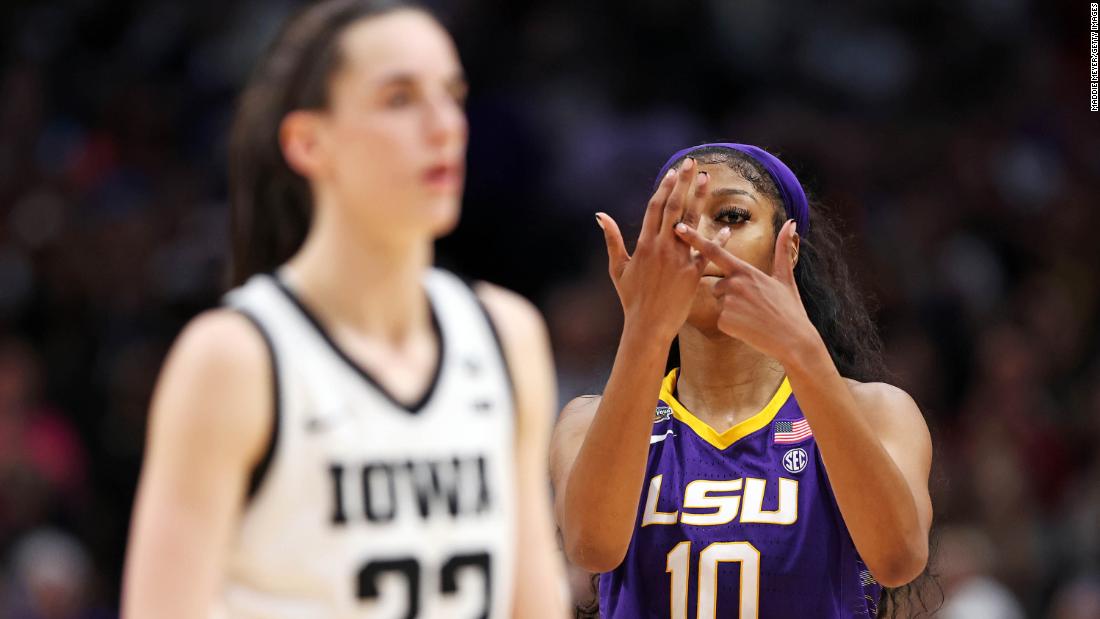
LSU star Angel Reese has ignited a fierce national conversation after defending the gesture she aimed at Iowa's Caitlin Clark in the waning moments of Sunday's NCAA women's basketball national championship game. With LSU securing its first national title in a 102-85 victory, Reese, named the tournament's Most Outstanding Player, performed a 'you can't see me' hand wave in front of her face and then pointed to her ring finger, directly targeting Clark as the clock expired. The moment, captured on broadcast and amplified across social media, instantly sparked a firestorm of reactions that divided fans and pundits alike.
In the post-game press conference, Reese addressed the controversy head-on. 'All year I was critiqued about who I am,' stated the 20-year-old forward. 'I'm not too one-sided for anyone to judge me. I did what I did at the end of the game, and I don't take disrespect lightly.' Reese explicitly linked her gesture to a similar one Caitlin Clark had made during the tournament, specifically in the Elite Eight game against Louisville, where Clark performed the same 'you can't see me' motion. 'Also, in the Elite Eight, she did the gesture to another player and everybody was like, 'Oh, she's so genuine,' and 'She's so cool.' But when I do it, it's something different,' Reese argued, highlighting what she perceives as a clear racial and personality double standard in media coverage and public perception.
The context is critical. Caitlin Clark, Iowa's white superstar, has been nationally celebrated for her audacious play and confident personality, gracing magazine covers and accumulating endorsements. Angel Reese, an equally dominant Black star known for her intensity and swagger, has faced criticism throughout the season for what some label 'cockiness.' This clash of narratives peaked on the sport's biggest stage. LSU coach Kim Mulkey also came to her player's defense. 'That girl plays with such passion and heart. Do you want her to be somebody she's not?' Mulkey asked reporters, emphasizing Reese's authenticity.
The game's statistics underscore Reese's monumental performance: 15 points, 10 rebounds, 5 assists, 3 steals, and 1 block, capping her record-tying season of 34 double-doubles. Yet, the post-game discourse quickly shifted from her athletic feat to the gesture and its societal implications. Sports and culture experts have noted this incident reflects a historical pattern where Black female athletes are penalized for expressions of confidence that are celebrated in their white counterparts. The discussion has transcended basketball, touching on issues of race, gender, sportsmanship, and athletes' freedom to be themselves.
The impact is multifaceted. For Reese, this has cemented her status as a polarizing yet undeniably powerful figure, willing to stand up for her identity. For the sport, it has sparked a necessary conversation about bias in sports coverage. For millions of young people, especially girls and women of color, Reese has emerged as a symbol of defiance and authenticity. 'I'm too fierce, I'm too hungry. I'm a dog. Period. And that's what I am,' Reese declared in the conference, reclaiming an epithet often used to criticize her.
In conclusion, Angel Reese's gesture and her subsequent defense have done more than generate headlines. They have exposed a fissure in how society consumes and judges female athletes. While LSU celebrates a historic milestone, the legacy of this game may be that it forced the sports world to confront its inconsistencies. Reese did not apologize for who she is, and in that act of defiance, she may have redefined what it means to be a champion, with all the complexity, passion, and pride it entails. The conversation about the double standard, once whispered in hallways, is now a shout from center court.