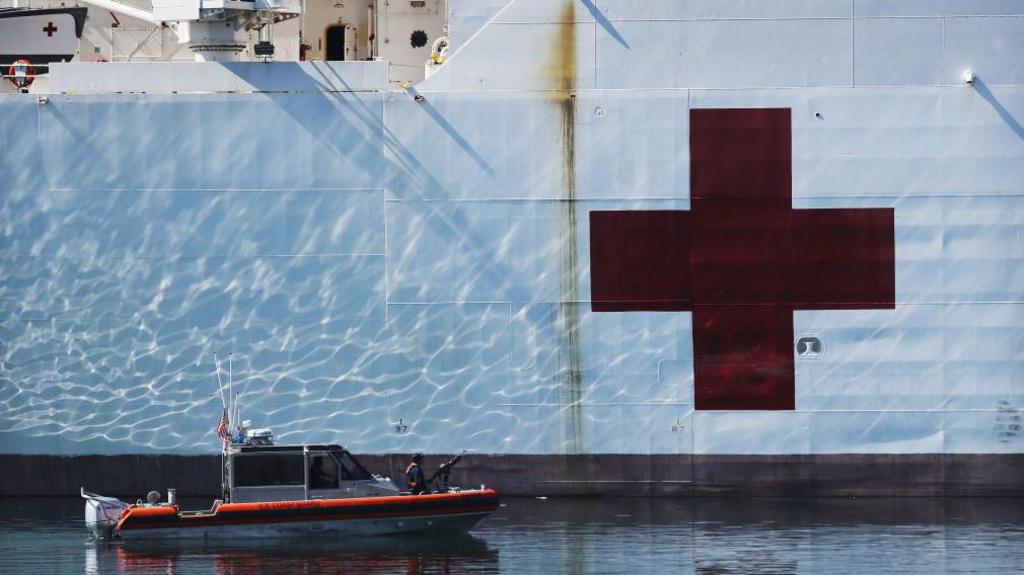
In a diplomatic move that underscores its growing autonomy and complex relationship with major powers, the government of Greenland has formally declined an offer from former U.S. President Donald Trump to deploy a U.S. hospital ship to its shores. The proposal, which according to sources close to the Greenlandic government was conveyed through informal channels, was seen as an attempt to bolster American influence on the strategic Arctic island, which is an autonomous territory within the Kingdom of Denmark. The rejection, communicated politely but firmly, reflects Nuuk's caution regarding any initiative that could be perceived as an attempt to undermine its sovereignty or its ties with Copenhagen.
The context of this offer lies within the growing geopolitical competition in the Arctic, a region rich in natural resources and whose strategic importance has increased with melting ice. The United States, through its Thule Air Base in northwestern Greenland, maintains a significant military presence. The Trump administration showed particular interest in the island, even suggesting in 2019 the possibility of purchasing it—an idea met with disbelief and rejection in both Denmark and Greenland. The hospital ship offer, typically used for humanitarian aid missions and medical diplomacy, was interpreted by analysts as a tool of 'soft power' to gain favor among the local population of approximately 56,000.
'Greenland has a robust and functional healthcare system, and we appreciate the gesture, but at this time we do not see the need for such assistance,' stated a spokesperson for Greenland's Ministry of Foreign Affairs. 'Our priority is cooperation based on mutual respect and on our own terms.' This stance was supported by the Danish government, which handles Greenland's defense and foreign policy. 'Denmark and Greenland coordinate closely on all matters of international relevance. We support the Greenlandic government's decision to assess its own needs,' added a Danish diplomat in Copenhagen.
The impact of this rejection is more symbolic than practical, but it sends a clear signal to Washington and other capitals about the evolving status of Greenland. The island is moving toward full independence in the long term, and its government carefully manages its relationships with external actors, balancing economic development—driven by mining, tourism, and fishing—with the preservation of its culture and environment. Rejecting an aid offer from a superpower, however well-intentioned it may seem, affirms its political agency. Experts on Arctic affairs note that this episode is unlikely to significantly chill U.S.-Denmark relations, which are NATO allies, but it does reinforce the narrative that Greenland is not a passive pawn on the geopolitical chessboard.
In conclusion, Greenland's refusal to accept Trump's hospital ship is a reminder that diplomacy in the High North requires sensitivity and a recognition of the self-determination aspirations of its populations. As tensions between Russia, China, and the West intensify in the Arctic, local actors like Greenland are demonstrating an increasing capacity to define the terms of their engagement. The future of the region will not be decided solely by great powers, but also by the sovereign decisions of communities that, like Greenland's, seek to forge their own destiny in a rapidly transforming world.