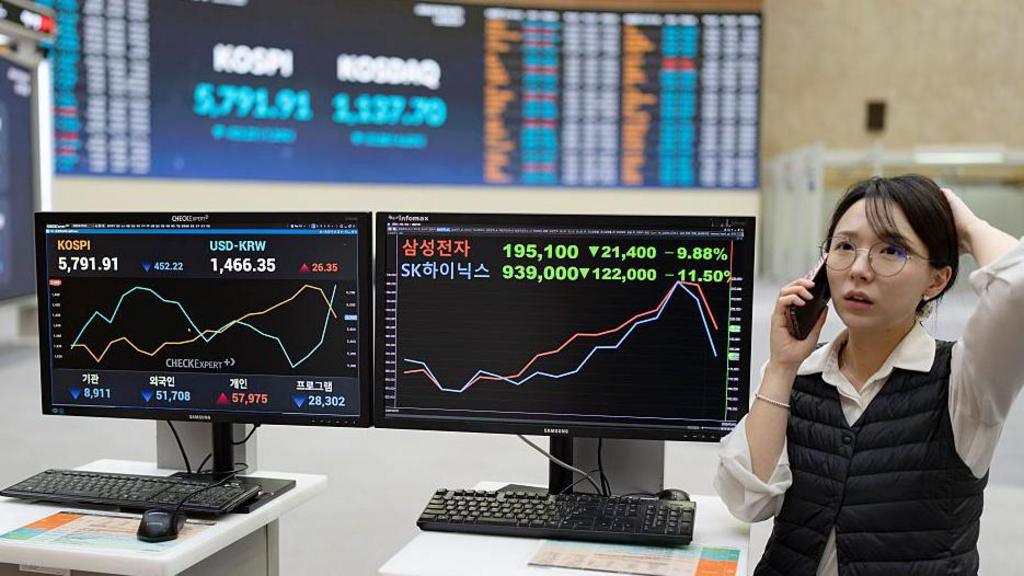
Asian financial markets extended their losses for a third consecutive session on Thursday, driven by a risk-averse atmosphere fueled by escalating geopolitical tensions in the Middle East. The primary catalyst for the uncertainty is the threat of military retaliation from Iran following an alleged Israeli attack on its consulate in Syria last week. This situation has triggered a clear rotation of capital into assets considered safe havens, such as the US dollar and gold, while equities are being sold off. The broad MSCI index for Asia-Pacific excluding Japan fell by 0.8%, with particularly sharp losses in the markets of Taiwan, South Korea, and Australia. Japan's Nikkei 225 also retreated, closing down 1.3%, hurt by the strength of the yen against the dollar, which weighs on major exporters.
The context for this volatility is a global landscape already complex, with central banks in major economies maintaining a restrictive stance to combat inflation, limiting the room for stimulus. The threat of open conflict in a region critical to global energy supply adds an extra layer of concern for investors. "Markets are operating in maximum caution mode," said Robert Carnell, chief economist for Asia-Pacific at ING. "Any direct military escalation between Iran and Israel would have immediate consequences for energy prices and could derail the fragile expectations for a global economic 'soft landing'," he added.
In the commodities market, oil prices posted moderate but significant gains, reflecting the geopolitical risk premium. The Brent crude futures contract for June delivery rose 0.9%, surpassing $90 per barrel, while US West Texas Intermediate (WTI) advanced 0.8%. Analysts point out that although production has not been affected, the mere risk of a disruption in the Strait of Hormuz—a critical chokepoint through which approximately 20% of the world's traded oil passes—is enough to sustain prices at elevated levels. Furthermore, OPEC+'s decision to maintain voluntary production cuts until mid-year continues to underpin the market.
The impact was also felt in currency and debt markets. The US dollar strengthened against a basket of currencies of its major trading partners, benefiting from its safe-haven status. In contrast, the currencies of net oil-importing countries, such as the Japanese yen and the Indian rupee, came under pressure. In the bond market, demand for sovereign debt from countries considered safe, such as US Treasuries and German Bunds, increased, causing a slight decline in their yields. This dynamic contrasts with the performance of bonds from more exposed emerging markets, which saw their risk premiums rise.
The takeaway for investors is that the window of stability has temporarily closed. The market's immediate priority will be to monitor any official statements from the governments in Tehran and Tel Aviv, as well as military movements in the region. As long as uncertainty persists, volatility is likely to remain high and the traditional correlation between equity performance and oil prices—normally negative for importers—is likely to become more pronounced. The episode serves as a stark reminder of how geopolitical shocks can quickly reconfigure economic and financial prospects in an interconnected world, forcing a portfolio rebalancing towards a more defensive profile.