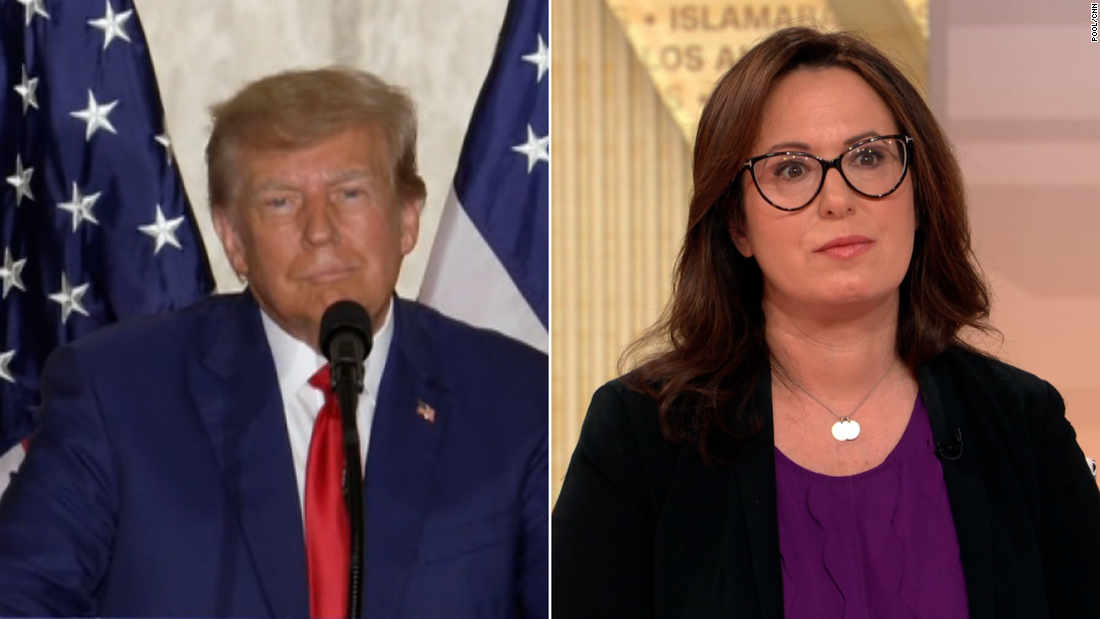
CNN political contributor Maggie Haberman, one of the journalists who has most closely covered Donald Trump's career, has provided a deep analysis of the rhetoric used by the former president following his arraignment in a Manhattan courtroom. According to Haberman, the personal attacks launched by Trump against Judge Juan Merchan and his family during a speech at Mar-a-Lago are not an emotional outburst, but a calculated and repeated political tactic. This strategy, the journalist explains, seeks several simultaneous objectives: to mobilize his most loyal base of supporters, to divert attention from the serious criminal charges he faces, and to establish a narrative framework of political persecution that permeates all media coverage.
The context is crucial. Trump faces 34 felony counts of falsifying business records related to alleged hush-money payments ahead of the 2016 election. It is the first time in U.S. history that a former president has been criminally indicted. In this high-stakes scenario, his initial reaction after the arraignment was predictable for those who have followed his career, Haberman argues. "Trump operates from a very well-tested playbook," explained the CNN contributor. "When he feels cornered or under an existential legal threat, his instinct is to counterattack in the most personal and visceral way possible. He doesn't attack the legal arguments; he attacks the people. He seeks to turn prosecutors and judges into villains in the story he narrates to his supporters."
Relevant data points to a concerning effectiveness of this tactic. Internal Republican Party polls show that, far from damaging Trump among primary voters, the legal proceedings have solidified his support. A speech that combines self-defense with victimhood and ad hominem attacks resonates with a segment of the population that deeply distrusts institutions. Haberman notes that the attack on Judge Merchan's daughter, whose consulting firm has worked for Democratic campaigns, is not accidental. "It connects directly to a larger conspiracy theory: that the 'deep state' and the left are coordinating a witch hunt against him. It's a two-tiered message: for the general public, it sounds like a complaint about bias; for his most committed base, it's confirmation that the whole system is rigged."
The impact of this rhetoric extends far beyond the Mar-a-Lago press room. Legal experts consulted by CNN express great concern about the erosion of public trust in the judiciary and the personal safety of the judge and his family. Historically, personal attacks by political figures against judges have been rare and widely condemned for crossing a fundamental democratic line: respect for judicial independence. However, in today's hyper-polarized politics, condemnation is partisan. While Democratic leaders and some moderate Republicans criticize Trump's comments, a large portion of the Republican congressional caucus remains silent or justifies them as "free speech."
In the long term, Haberman warns that this strategy has profound implications for the country. "It normalizes what was once unthinkable. If a former president and a leading presidential candidate can call a judge 'biased' and attack his family without massive political consequences, what boundary remains?" she asks. The conclusion of her analysis is grim: these attacks are not an isolated episode, but the prologue to an electoral campaign that will play out in courtrooms as much as at rallies. Trump has shown that he intends to make his criminal trial, and any others that may arise, the centerpiece of his campaign narrative. American justice, and the public perception of its impartiality, thus face an unprecedented stress test, where words spoken at a Florida resort may have the power to undermine centuries-old institutional pillars.