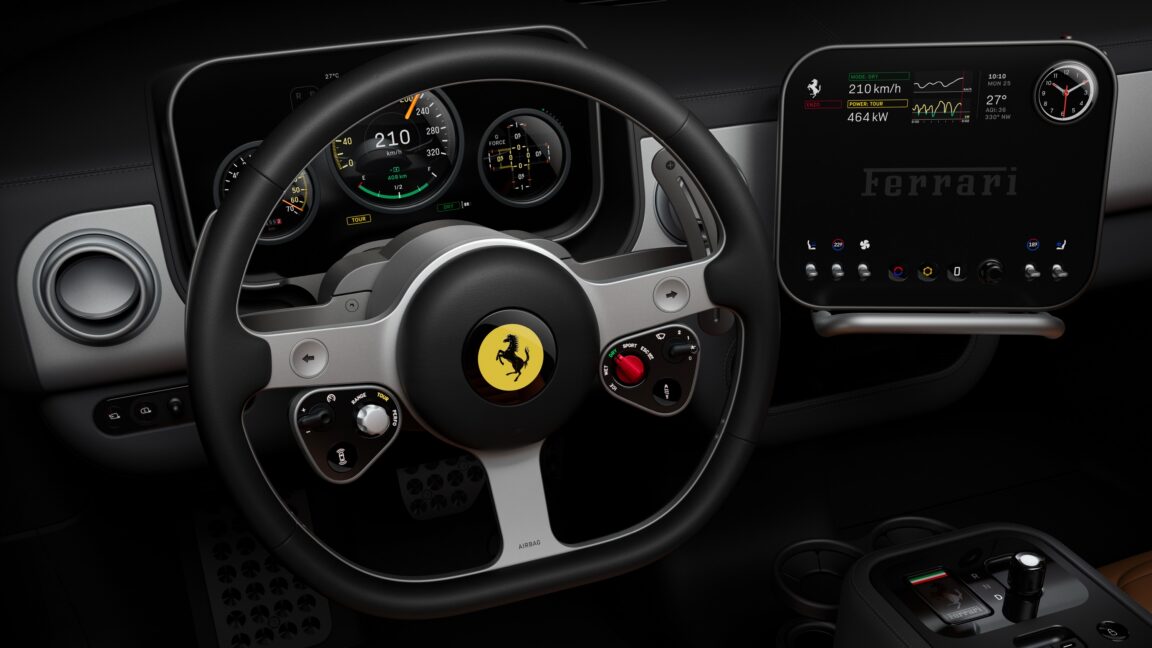
Ferrari, the legendary supercar manufacturer from Maranello, is on the verge of a historic leap into full electrification with its first all-electric vehicle, provisionally known as the 'Ferrari Luce'. However, far from diving into a minimalist, digital future, the marque has entrusted the design of the interior to two of the world's most revered creative minds: Sir Jony Ive, former Chief Design Officer of Apple, and Marc Newson, the renowned industrial designer. Their mission, according to early indications, is to preserve the tactile and emotional essence of driving a Ferrari, even as the combustion engine fades away. The result promises to be a cabin where analogue dials, aluminum switches, and a plethora of physical buttons will reclaim center stage, challenging the current trend of giant touchscreens.
This approach represents a bold statement of intent in an industry that, over the past decade, has equated innovation with the total digitization of the driver's experience. While most manufacturers, including luxury ones, fill their dashboards with panoramic screens and complex digital menus, Ferrari, Ive, and Newson are betting on physical connection and sensory quality. Materials like machined aluminum, premium leather, and potential inserts of sustainable substances will be paramount. Every switch, every dial, and every button will be designed to offer precise and satisfying tactile feedback, evoking the precision of an aircraft instrument or a luxury mechanical watch. This philosophy aims to ensure the driver is not merely a software operator, but a pilot in communion with the machine.
The context of this project is critical. Ferrari has been exploring electrification through its hybrids, like the SF90 Stradale, but the Luce will be its first pure-blood electric vehicle. The challenge is not only technical (developing a high-performance EV platform) but also philosophical: how do you convey the emotion and character of a brand built on the roar of a V12 in a silent vehicle? The answer appears to lie in touch, sight, and physical interaction. According to sources close to the project, Ive and Newson have been working on the car's 'human interface' for over two years, insisting that technology must serve the experience, not dominate it. Classic elements, such as the tachometer or the manettino selector (the driving mode dial), are expected to retain their physical presence, albeit with possibly new functions adapted to electric propulsion.
While Ferrari has not made official statements on specific details, the collaboration itself is a powerful message. Jony Ive, the architect of the iconic design of products like the iPhone and MacBook, brings an obsession with simplicity, usability, and exquisite materials. Marc Newson, on the other hand, is known for his ability to fuse the organic with the technical in objects ranging from watches to furniture and aircraft. Together, their goal is not to turn back the clock, but to rescue the timeless values of high-performance automotive design for a new era. 'The thrill of driving a Ferrari has always been multisensory,' a brand spokesperson might argue. 'Sound is one part, but the feel of the steering wheel, the click of a switch, the instant readability of a dial... that's what creates an irreplaceable bond.'
The impact of this decision could resonate far beyond Maranello. In a premium market where Tesla defined the aesthetic of the central screen and others have followed suit, Ferrari's bet on an 'analogue' interior could inspire other manufacturers to reconsider the importance of physical interaction, especially in segments where the driving experience is the core product. It also raises a fascinating question about the future of luxury in electric mobility: will supreme luxury be digital simplicity or tactile, tangible craftsmanship? For Ferrari purists and collectors, this approach may be a balm, a signal that the brand will protect its soul even as it embraces new technology.
In conclusion, the first all-electric Ferrari will mark not only a technological milestone but also a cultural stance in automotive design. By commissioning Ive and Newson to create an interior focused on analogue dials, aluminum switches, and physical buttons, Ferrari is betting that the thrill of driving can be preserved through tactile quality and intuitive interaction. This project suggests that the future of electric supercars does not have to be cold and digital, but can be imbued with the warmth, character, and old-school charm that have defined the legendary prancing horses for decades. The automotive world eagerly awaits to see how this philosophy materializes in the Luce, a car that could redefine what luxury and performance mean in the post-combustion era.