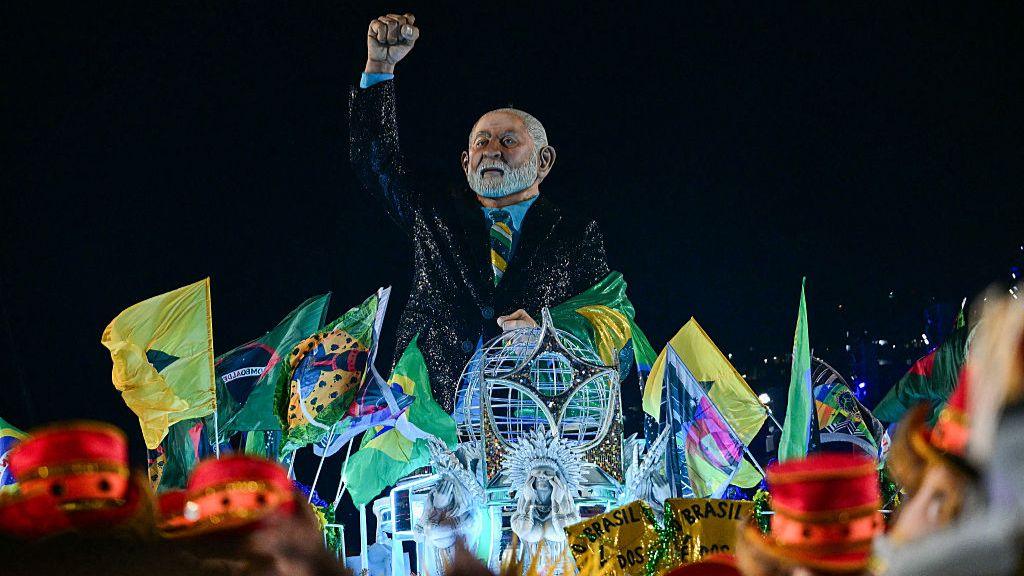
The samba school parade at the Rio de Janeiro Carnival, one of the world's grandest spectacles, was tinged with political controversy this year. The Unidos da Tijuca samba school, which featured a central float with a gigantic representation of Brazilian President Luiz Inácio Lula da Silva, placed last in its group, the Special Group, according to official results announced this Wednesday. The defeat resonated far beyond the Sambadrome, instantly becoming a symbol in Brazil's polarized political landscape, where the passions of carnival often mirror societal tensions.
Unidos da Tijuca's parade theme was 'The Cry of the People in the Streets,' a tribute to popular demonstrations and democracy. The visual highlight was a towering float depicting Lula with open arms, dressed in a white shirt and vest, against a backdrop of Brazilian flags and crowds. The parade's narrative celebrated Lula's return to the presidency in 2023 after a tightly contested election against former President Jair Bolsonaro. However, the carnival judges, who evaluate elements such as harmony, drumming, evolution, wings, and costumes, awarded the school low scores in several categories, culminating in an overall twelfth and last place position.
The result prompted immediate and divided reactions. Government supporters and left-leaning commentators questioned the jury's impartiality, suggesting the verdict might be tinged with political bias in a country where carnival is never completely divorced from politics. On the other hand, critics and opponents of Lula celebrated the result on social media, interpreting it as a popular rejection of his administration, even though the evaluation criteria are technical and artistic. Carnival experts, such as anthropologist Maria Laura Viveiros de Castro, explained to the press that 'carnival is a mirror, but a distorted one, of society. A school that chooses such a contemporary and divisive theme assumes an enormous risk. The jury may, consciously or unconsciously, be influenced by the political climate, or simply the artistic execution may not have been convincing.'
The context is crucial. Brazil remains deeply divided following the bitter 2022 elections. Carnival, traditionally a space for social criticism and satire, has seen increasing politicization in recent years. While some wings of the parade displayed banners with pro-Lula and pro-democracy slogans, isolated incidents of booing from the stands were reported during the float's passage. The Unidos da Tijuca school, for its part, issued a statement respecting the jury's result but expressing pride in its parade and the message it brought to the avenue. 'We defend art, culture, and freedom of expression. Our tribute to the Brazilian people and their struggle remains,' the text stated.
The impact of this episode transcends the world of samba. It has become a new reference point in the Brazilian culture wars, used by both sides to reinforce their narratives. For Lula's administration, it may serve as a reminder of the fragility of its support in certain sectors, even at a massive and popular event. For the opposition, it is a symbol of resistance. Political analysts, however, warn against overreading a carnival result. Political columnist Fernando Schüler wrote: 'Carnival is not an opinion poll. It is art, emotion, and subjectivity. Turning a samba school's twelfth place into a political thermometer is reducing the complexity of democracy to a single number, no matter how spectacular the staging.'
In conclusion, the last-place finish of the Lula float at the Rio Carnival is an episode rich in meaning. It illustrates the inextricable fusion of culture and politics in contemporary Brazil, where even the planet's biggest party cannot escape societal fissures. As the drums fall silent and the feathers are stored away, the debate this parade triggered continues, proving that in Brazil, carnival is never just carnival. It is a narrative battleground, a space where the nation's joys and pains are displayed in all their splendor and conflict, leaving an echo that will resonate long after the last float has passed.