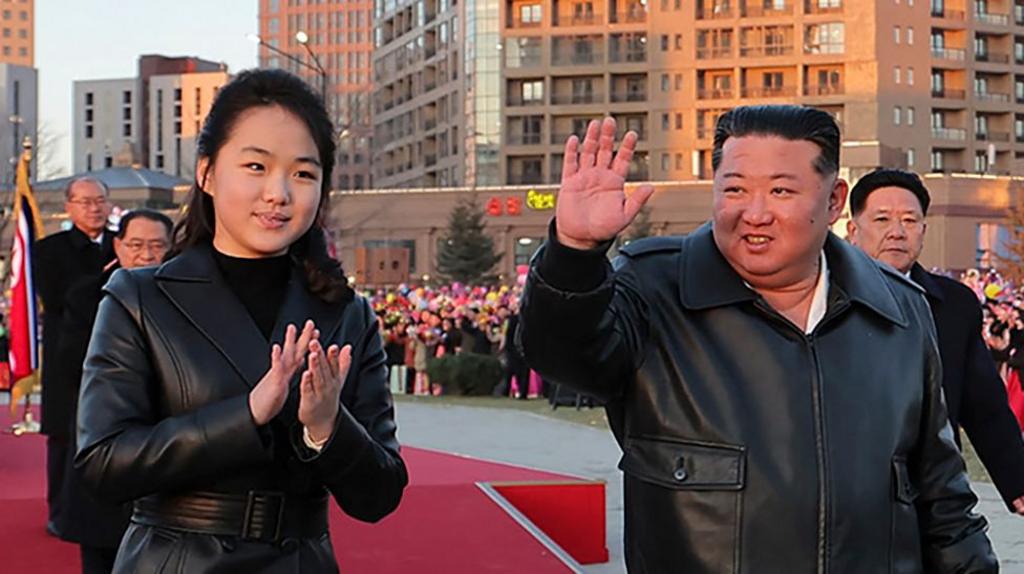
The public appearance of Kim Ju-ae, the daughter of North Korean Supreme Leader Kim Jong-un, at a series of high-profile events, including a missile launch, has sparked intense debate among international analysts and observers about the possibility of her being groomed for succession. At just around 10 years old, her presence alongside her father at occasions traditionally reserved for top military officials and party cadres marks a significant shift in the opaque politics of the Kim dynasty. This move has led many to wonder whether Pyongyang is laying the groundwork for a future transfer of power to a fourth generation, which would be an unprecedented event in the history of the regime.
The context of this potential succession is set against a backdrop of rising geopolitical tensions and the consolidation of Kim Jong-un's power, who assumed leadership after his father, Kim Jong-il, died in 2011. The Kim dynasty has ruled North Korea since its founding in 1948, maintaining tight control through personality cults, military apparatus, and the Workers' Party. Introducing a female figure, and moreover a child, into the line of succession would challenge deeply ingrained patriarchal norms in North Korean society and its ruling elite. However, recent gestures, such as dubbing Kim Ju-ae "the most beloved child" and highlighting her role in state events, suggest a carefully orchestrated propaganda campaign to familiarize the population with her image.
Relevant data indicates that succession in North Korea has always been a critical state affair, shrouded in secrecy and, at times, violent purges. Kim Jong-un himself was groomed for years before assuming the role, although his designation was not officially confirmed until after his father's death. In Kim Ju-ae's case, North Korean state media has progressively increased its coverage, showing her at military base visits and meetings with scientists. While no official statement has been made regarding her status as heir, the rhetoric used, comparing her to her grandfather Kim Jong-il in his youth, is interpreted by many experts as a clear hint of her future role.
Some analyst statements reflect the division of opinions. "The promotion of Kim Ju-ae is a strategic move to ensure dynastic continuity and project stability at a time when North Korea faces international sanctions and economic challenges," said a researcher at the Center for Strategic and International Studies. On the other hand, others warn it could simply be a tactic to reinforce Kim Jong-un's image as a family-friendly and accessible leader, without committing to long-term succession. So far, Pyongyang has not directly commented on these speculations, maintaining its characteristic ambiguity on leadership matters.
The impact of this potential succession would be profound, both domestically and internationally. Domestically, establishing a young woman as a future leader could generate resistance within traditional power structures, dominated by older men. However, it could also serve to renew the regime's legitimacy among a younger population. Internationally, neighboring countries and global powers like the United States, China, and South Korea would be closely watching for any signs of instability or change in Pyongyang's direction, given North Korea's crucial role in regional security and its nuclear program.
In conclusion, while it is too early to state with certainty that Kim Ju-ae is destined to succeed her father, evidence points to a deliberate effort to elevate her to a special status within the North Korean hierarchy. Succession in a regime as closed as North Korea's always carries risks and uncertainties, but the inclusion of a female figure in the official narrative opens a new chapter in the history of the Kim dynasty. The coming years will be crucial to observe how this process evolves and whether Pyongyang decides to break with century-old traditions to pave the way for its first female leader.