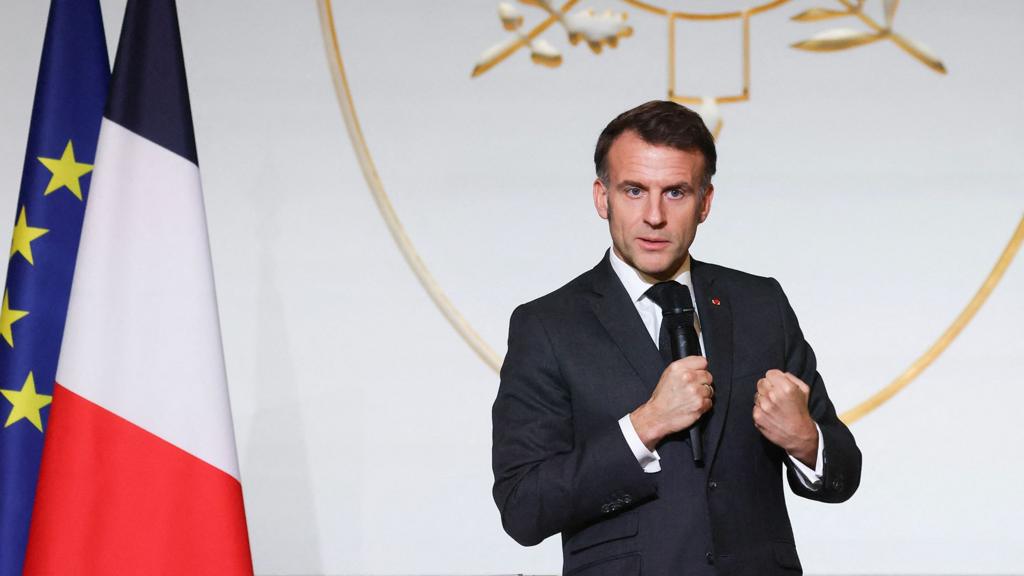
In a speech that resonated as a strategic wake-up call, French President Emmanuel Macron urged the European Union to shed its role as a secondary actor in global geopolitics and begin acting as a genuine world power. The warning, delivered during an address to European leaders and foreign policy analysts, underscores the perception that Europe faces a historic "wake-up call," driven by growing threats emanating not only from traditional rivals like China and Russia but also from a historic ally: the United States. Macron argued that the continent can no longer afford to rely on the protection of others, nor passively navigate the clashes between great powers, but must forge its own path, with strategic autonomy and a cohesive defense as fundamental pillars.
The context for this statement is a Europe at a crossroads. Russia's war of aggression in Ukraine has starkly exposed the bloc's energy and security vulnerabilities. Simultaneously, systemic competition with China, both in technology and economic influence, is intensifying. However, the most novel and provocative element of Macron's analysis is the identification of U.S. policies, particularly the Inflation Reduction Act (IRA), as a destabilizing factor for European interests. Macron pointed out that America's massive subsidies and green protectionism risk deindustrializing Europe, drawing crucial investments and factories across the Atlantic. "Our model is being challenged by our closest allies," he stated, in a remark reflecting growing frustration in European capitals.
Data supports the concern. Foreign direct investment in advanced manufacturing and clean technologies is shifting significantly toward North America, incentivized by the U.S. stimulus package. In parallel, Europe's defense spending, while increased following the Russian invasion, remains fragmented across 27 national armies, diluting its effectiveness. Macron advocated for a quantum leap in European defense integration, including more joint spending, the development of indigenous industrial capabilities, and a unified strategic doctrine. "European sovereignty is not a slogan; it is the condition for our future existence in a world of predators," he declared, using unusually direct language.
The impact of this call is multifaceted. Internally, it seeks to galvanize an often-divided and bureaucratic EU, pushing for concrete projects like a common industrial policy and a deeper capital market to finance the green and digital transitions. Externally, it sends a clear message to Washington, Beijing, and Moscow: Europe intends to be an autonomous pole of power, capable of defending its values and economic interests without automatic alignment. However, the path is fraught with obstacles. Divergences among member states over the relationship with the United States, the pace of defense integration, and the distribution of the financial burden are profound. Eastern countries, for instance, still see NATO and the U.S. as the ultimate guarantor of their security.
In conclusion, Macron's speech marks a potential turning point in the European narrative. It is no longer just about managing crises in the neighborhood, but about defining a global role in a rapidly decaying international order. The success of this vision will depend on Europe's ability to translate words into deeds: mobilizing colossal resources, overcoming short-sighted nationalism, and building a true union of power, not just of rules. If it fails, Macron warned, Europe risks becoming a mere spectator, or worse, a pawn, in the new great power game. The coming decade will be the ultimate test of whether the continent can answer this existential wake-up call.