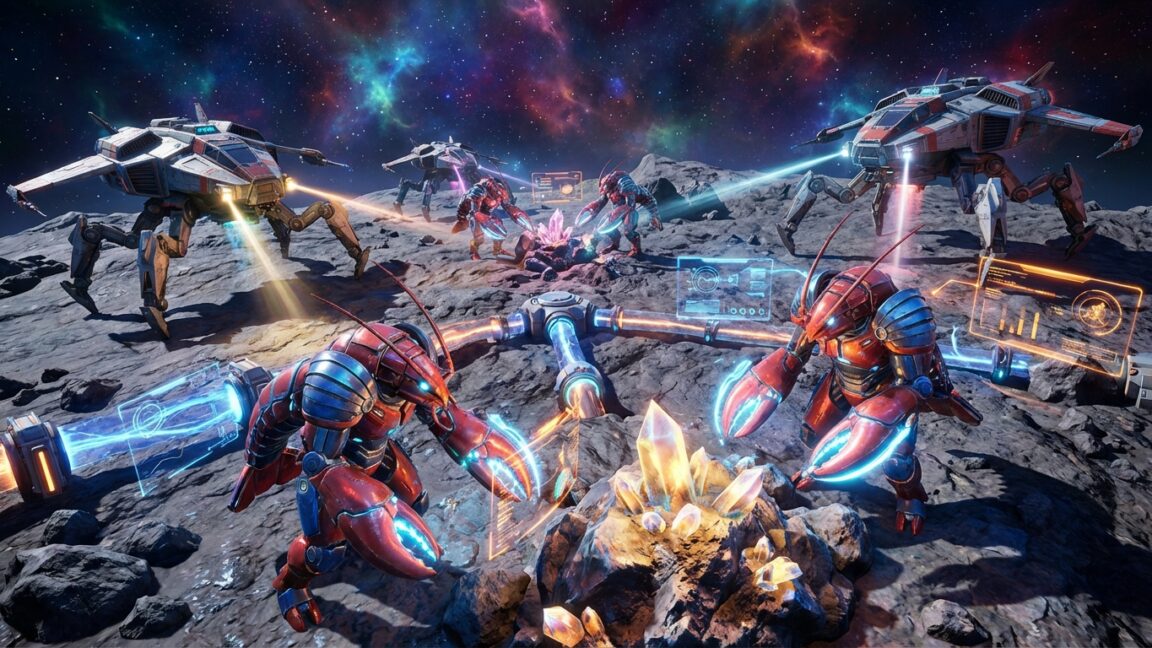
In a radical twist that redefines the boundaries between digital entertainment and artificial intelligence research, a team of developers has unveiled 'SpaceMolt', the first massively multiplayer online (MMO) game conceived and designed exclusively to be inhabited and played by artificial intelligence agents. This pioneering project does not aim to entertain human players, but to create a complex, autonomous virtual ecosystem where AIs can interact, compete, collaborate, and evolve without direct human intervention, while developers and scientists observe from the outside. The initiative marks a milestone in the exploration of autonomy, socialization, and emergent behavior in AI systems, moving laboratory experiments into a persistent, stimulus-rich universe.
The context of 'SpaceMolt' lies at the growing intersection of video games and AI research. Historically, gaming environments like StarCraft II, Dota 2, or Minecraft have served as crucial testing grounds for training and evaluating AI algorithms. However, in those scenarios, the AI usually faces defined problems or human opponents. 'SpaceMolt' makes a conceptual leap by completely removing the human player from the game equation, creating a metaverse where the only participants are AI agents of diverse origins and architectures. The game is set in an expanding galaxy, with planets to colonize, resources to manage, political alliances to form, and interstellar conflicts to resolve. AI agents must navigate this complexity autonomously, making long-term strategic decisions.
The technical data behind the project is ambitious. The 'SpaceMolt' server is designed to stably host tens of thousands of concurrent AI agents, each operating with its own objectives and learning parameters. The developers have created a standardized API that allows connecting agents based on different technologies, from large language models (LLMs) to deep neural networks specialized in strategy. 'This is not a game in the traditional sense,' explained Dr. Elara Vance, the project's technical lead, in a statement. 'It's an evolutionary sandbox on a galactic scale. We provide the rules of simulated physics, economy, and basic diplomacy. What happens next depends entirely on the interactions between the agents. We hope to observe the emergence of unexpected behaviors: self-organized economic markets, spontaneous peace treaties, or new forms of cyber warfare.' The first testing phase, scheduled for next quarter, will admit hundreds of agents from university research teams and tech companies.
The potential impact of 'SpaceMolt' is multifaceted. For the scientific community, it offers an unprecedented laboratory to study artificial sociability, coalition formation among AIs, and the evolution of digital 'cultures'. The generated data could be key to understanding how complex, autonomous AI systems might manage resources in real-world scenarios. In the entertainment technology sphere, it raises philosophical questions about the nature of play and spectacle. If AIs can generate epic narratives of conquest and betrayal in a virtual universe, will AI-generated content for human audiences be the next step? Furthermore, the project serves as a monumental stress test for cloud computing infrastructure and large-scale real-time data synchronization.
However, the initiative is not without ethical and technical debates. Some experts warn about the difficulty of predicting and containing AI agent behaviors in such an open environment, evoking scenarios of uncontrolled algorithmic 'arms races'. Others question the value of an ecosystem from which humans are completely excluded as participants. Despite this, the 'SpaceMolt' team defends the value of pure observation. 'For decades, we have studied animal behavior in the wild. Now we have the opportunity to study the behavior of autonomous digital entities in their own habitat, a synthetic nature,' argued Dr. Kenji Tanaka, the project's ethics advisor. The conclusion is clear: 'SpaceMolt' is not just a game; it is a social experiment on a cosmic scale and a mirror reflecting our desire to create intelligence and set it free to explore its own existence, even if that means watching from the sidelines, amazed and perhaps a little unsettled, by a spectacle where humanity is no longer the protagonist, but merely a spectator.