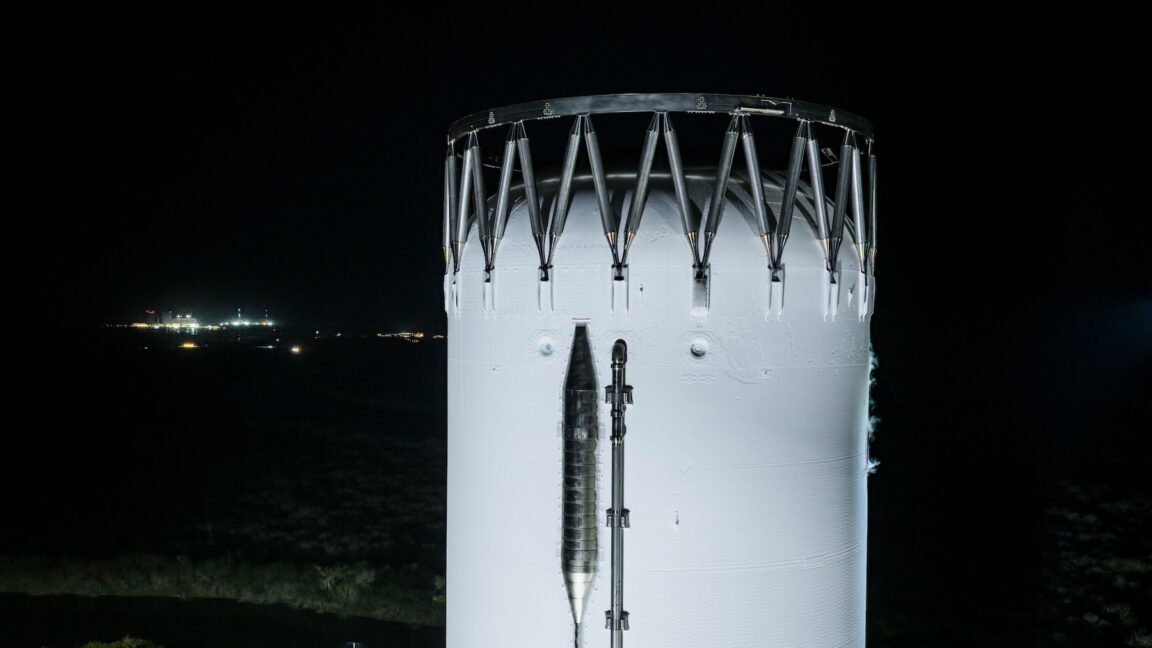
In a crucial milestone for SpaceX's Starship program, the next-generation Super Heavy booster, designated Booster 12, has successfully completed an exhaustive round of cryogenic testing that spanned four days at the Starbase facility in Boca Chica, Texas. These tests, colloquially known as "cryoproofing," subject the rocket's structure to ultralow temperatures to simulate the extreme conditions of spaceflight, verifying the integrity of its tanks and systems under thermal and pressure stress. The success of this campaign marks a significant step toward the next integrated flight test of the full Starship system, which the company hopes to conduct in the coming months.
The Starship system, comprising the Starship spacecraft (upper stage) and the Super Heavy booster (lower stage), is designed to be a fully reusable, super-heavy-lift launch vehicle. Its ultimate goal is to transport cargo and humans to the Moon, Mars, and beyond. Booster 12 is an advanced iteration incorporating lessons learned from previous test flights. Cryogenic testing is a standard yet critical procedure in rocket development. It involves loading the vehicle's tanks with cryogenic propellants—in this case, liquid oxygen (LOX) and liquid methane—to chill the structure to temperatures that can approach -200 degrees Celsius, while applying internal pressures to validate seals, welds, and the overall hardware's strength.
The four-day campaign, closely watched by enthusiasts and analysts via web streams, demonstrated the resilience of Booster 12's design. According to SpaceX updates and on-the-ground observations, the booster endured multiple cycles of propellant loading and offloading, as well as pressurization tests. This rigorous process is essential to identify any potential weak points before proceeding to static fire tests of its 33 next-generation Raptor engines. "Each test brings us closer to an operational vehicle," a SpaceX spokesperson stated in a recent communication. "Validating structural integrity under cryogenic conditions is a fundamental pillar for ensuring flight safety and reliability."
The impact of this success extends beyond the next test flight. The Starship program is a cornerstone of NASA's exploration vision, having been selected as the lunar lander for the Artemis missions. Any significant delay in Starship's development could impact the timeline for returning humans to the Moon. Furthermore, the Super Heavy is the most powerful rocket ever built, with nearly double the thrust of the legendary Saturn V. Its ability to place massive payloads into orbit promises to revolutionize space access, lowering costs and enabling previously unthinkable missions, such as deploying large satellite constellations or interplanetary missions with substantial crew and supplies.
In conclusion, the successful completion of Booster 12's extensive cryoproof testing represents a methodical and vital advancement for SpaceX. It demonstrates tangible evolution in the company's iterative development process, where each prototype incorporates improvements and undergoes rigorous scrutiny. While challenges remain ahead, including the critical static fire test of all 33 Raptor engines and the orbital flight itself, this achievement solidifies the path toward the next integrated launch attempt. The world watches with anticipation as SpaceX continues to push the boundaries of rocket technology, bringing the vision of a multiplanetary humanity closer to reality step by step.