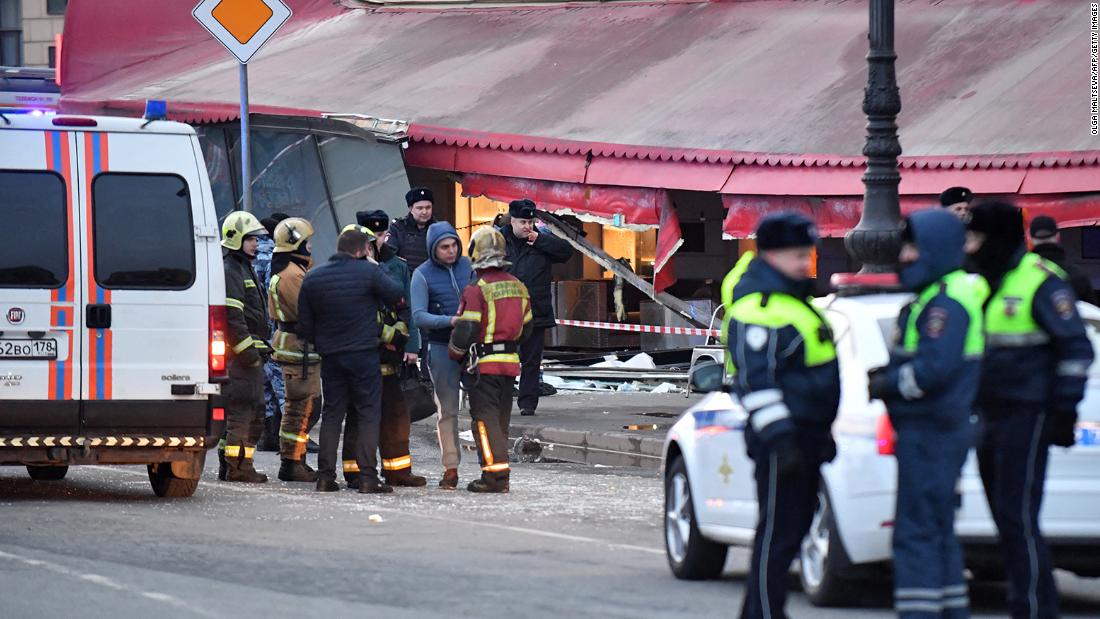
Russian authorities announced on Monday the detention of a suspect in connection with an explosive device blast at a popular cafe in central St. Petersburg, an incident that killed one person and injured at least 30 others, six of them seriously. The event, initially classified as an act of terrorism by Russia's Investigative Committee, has shocked the nation's second-largest city and triggered a large-scale security response, with a heavy police deployment in the area of Nevsky Prospect, one of the city's main thoroughfares.
The explosion occurred on Sunday afternoon at "Street Food Bar No. 1," located in a historic building. According to witnesses cited by Russian news agencies, an improvised explosive device detonated inside the premises, causing a violent blast that shattered windows and scattered shrapnel and debris onto the sidewalk. Footage shared on social media and local media shows broken glass, overturned tables, and furniture debris. Emergency services quickly arrived at the scene to evacuate the wounded and establish a security perimeter. The deceased victim was identified as a 27-year-old man who was in the cafe at the time of the explosion.
The Investigative Committee, Russia's main criminal investigation agency, immediately opened a criminal case on terrorism charges. In a statement, they indicated that "according to preliminary data, a homemade explosive device was detonated in the establishment." Hours later, the national security service, the FSB, announced the detention of a suspect, a man originally from a Central Asian republic, without providing further details on his identity or possible motives. The detention followed a joint operation with police. The investigation now focuses on determining whether the individual acted alone or as part of a cell, as well as clarifying the origin and nature of the explosive used.
This incident revives fears about security in Russian public spaces, which have been targeted by attacks in the past. St. Petersburg, in particular, was the scene of a 2017 metro bombing that killed 15 people, claimed by a suicide bomber linked to extremist groups. The current context, marked by the conflict in Ukraine and internal tensions, adds a layer of complexity to the investigation. Authorities have not yet established a clear link to the conflict, but analysts note that Russia has faced a series of sabotage incidents and attacks since the start of the large-scale invasion in February 2022.
St. Petersburg Mayor Alexander Beglov expressed his condolences to the victims' families and assured that all necessary measures were being taken. "Special services are working. The goal is to identify everyone involved," he stated. Meanwhile, Kremlin spokesman Dmitry Peskov reported that President Vladimir Putin had been immediately informed of the incident and was receiving constant updates. The official response has combined a promise of a rigorous investigation with calls for calm to avoid panic among the population.
The impact of the attack goes beyond the immediate aftermath. The affected cafe is located in a highly trafficked tourist and commercial area, and the incident has raised alarms about the vulnerability of such spaces. Furthermore, it occurs at a time of high political sensitivity, with Russia under international sanctions and in the midst of a war effort. The ability of security forces to prevent this type of act and the official narrative constructed around the attack will be crucial for internal stability. As the investigation continues, the city of St. Petersburg tries to return to normalcy, but under the shadow of a tragedy that reminds us of the persistent threat of violence in the heart of its streets.