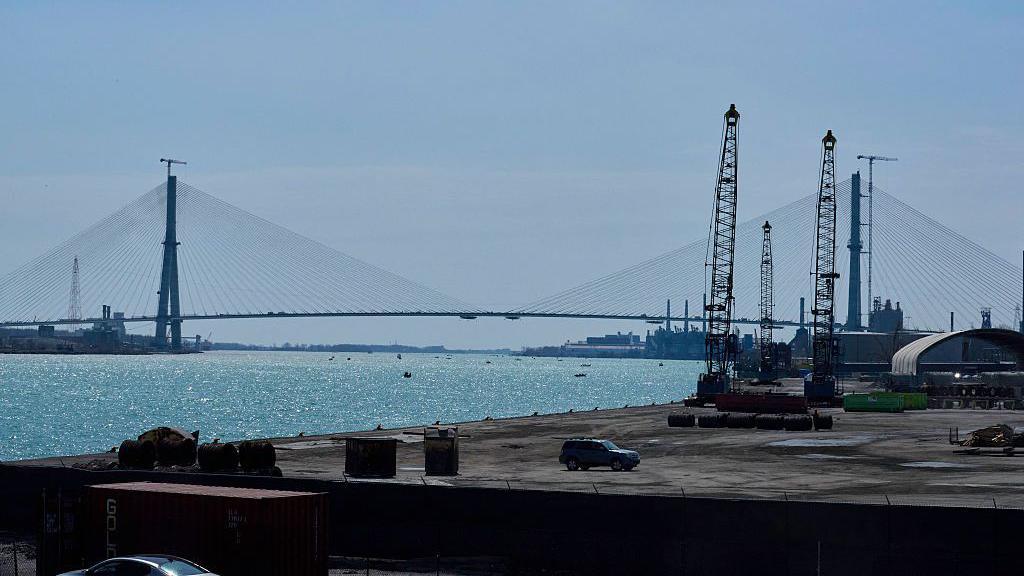
Former U.S. President Donald Trump has ignited a fresh international controversy by threatening to block the opening of the Gordie Howe International Bridge, a crucial piece of infrastructure linking Michigan with Ontario, Canada, and slated to open later this year. The statement, made during a campaign rally, has put governments, businesses, and communities on both sides of the world's longest border on high alert, a border that heavily relies on uninterrupted trade and tourist flow. The bridge, with a price tag of approximately 5.7 billion Canadian dollars, represents one of the most significant binational infrastructure investments in recent decades and is seen as a pillar for the economic competitiveness of the Great Lakes region.
The context of this threat is framed within Trump's political rhetoric on international trade and his historic renegotiation of the United States-Mexico-Canada Agreement (USMCA). During his presidency, Trump repeatedly criticized Canada for what he deemed unfair trade practices, even imposing tariffs on Canadian steel and aluminum. The Gordie Howe Bridge, designed to alleviate congestion at the nearby, aging, and privately-owned Ambassador Bridge, symbolizes precisely the cooperation Trump has questioned. Its construction has been a joint effort led by the Canadian government, which funded the majority of the project, and the state of Michigan, with U.S. federal support.
Relevant data underscores the critical importance of this crossing. According to Statistics Canada and the U.S. Bureau of Economic Analysis, bilateral trade between the two countries exceeded $1.2 trillion in 2023, with over 20% of that volume moving through the Detroit-Windsor region, the busiest land-based trade corridor in North America. The Ambassador Bridge, currently the primary crossing, handles approximately 8,000 trucks daily, but its capacity is maxed out and its structure dates back to 1929. The new six-lane bridge will not only double capacity but also incorporate dedicated lanes for cyclists and pedestrians, projected to handle over 15,000 commercial vehicles per day once operational.
In statements captured by U.S. media, Trump claimed, 'We have to look at every project, every penny that leaves this country. That bridge is a gift to Canada, and if we don't get a fair deal, we'll stop it.' In response, Canadian Prime Minister Justin Trudeau replied measuredly, stating at a press conference, 'This project is the result of years of joint work for the benefit of workers and businesses on both sides of the border. Cooperation is the foundation of our shared prosperity.' Meanwhile, Michigan Governor Gretchen Whitmer issued a statement emphasizing that 'the bridge is vital to our state's economy and is nearly complete. Any attempt to stop it would be detrimental to thousands of jobs in Michigan.'
The potential impact of blocking the opening is multifaceted and severe. In the short term, it would jeopardize thousands of direct and indirect jobs linked to the bridge's construction and operation. In the medium term, uncertainty could deter additional investment in the region and increase logistical costs for key industries like automotive, agriculture, and manufacturing, which depend on just-in-time supply chains. Legally, constitutional experts note that a president would have limited authority to halt a completed interstate infrastructure project, but judicial processes could delay the opening for months or years, creating a harmful limbo. Furthermore, the threat could chill diplomatic relations at a time of growing global geopolitical competition, where allies like Canada are crucial for North American security.
In conclusion, Donald Trump's threat against the Gordie Howe International Bridge transcends mere campaign rhetoric and endangers a strategic, nearly completed infrastructure project. It reveals persistent tensions in the vision of international trade and sovereignty and tests the resilience of binational institutions. Although the opening remains scheduled for September 2024, the shadow of political uncertainty could have a chilling effect on regional economic planning. This episode serves as a reminder that, in an era of polarization, even the most consensual and technical projects can become pawns on the political chessboard, with real consequences for North American economic integration and stability.