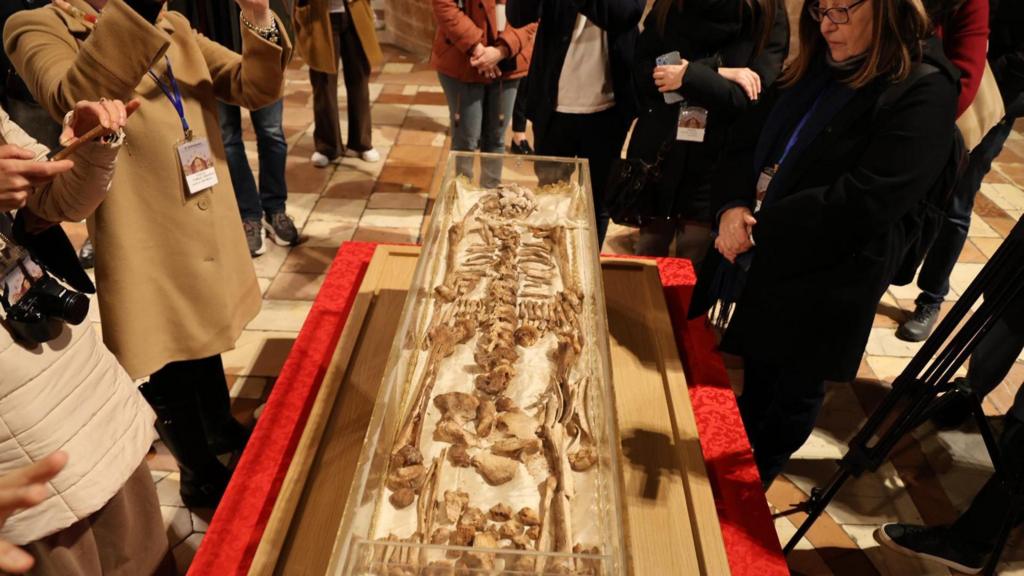
In an unprecedented historic event, the skeletal remains of St. Francis of Assisi, one of Christianity's most venerated saints, have been put on public display at the Basilica of St. Francis in Assisi, Italy. The exhibition, coinciding with the 800th anniversary of the founding of the Franciscan Order, allows pilgrims and visitors to view the bones of the patron saint of Italy and animals, marking a moment of profound religious and cultural significance. The decision to display the relics, typically kept in a sealed crypt, was made by ecclesiastical authorities after careful discernment, aiming to offer a tangible experience of faith in an increasingly secularized world.
St. Francis of Assisi, born Giovanni di Pietro di Bernardone in 1181, renounced a life of wealth to embrace absolute poverty, founding the Order of Friars Minor. His legacy of humility, love for nature, and commitment to the poor has transcended centuries and borders, inspiring millions. The remains, discovered during archaeological excavations in the 19th century, have been the subject of discreet veneration, preserved in a reliquary within the basilica. The current display includes significant bone fragments, presented in a context that explains the saint's life and work, with informational panels and multimedia elements detailing his impact on spirituality and art history, from Giotto's frescoes to Pope Francis's encyclical "Laudato Si'."
According to data provided by the Diocese of Assisi, over one million people are expected to visit the exhibition during the months it will be open, generating significant economic and touristic impact in the Umbria region. The cardinal in charge of the basilica stated: "This is a unique opportunity to approach the essence of Francis, not as a distant figure, but as a man whose radical surrender to God transformed the world. By seeing his bones, we remember that holiness is embodied in human fragility." The statement resonates in an ecclesiastical context where relics remain a powerful symbol of connection with the divine, despite modern debates about their role.
The impact of this event extends beyond the religious sphere. Historians and anthropologists highlight its value for understanding medieval devotional practices and their evolution. Furthermore, the exhibition has spurred collaborations with cultural institutions, including loans of Franciscan manuscripts from European libraries. For the city of Assisi, a UNESCO World Heritage Site, this moment reinforces its identity as a global pilgrimage center, attracting both believers and curious individuals interested in historical heritage.
In conclusion, the public display of St. Francis of Assisi's bones represents a bridge between past and present, inviting reflection on perennial values such as simplicity, compassion, and care for creation. More than a mere historical curiosity, it is a tangible testimony of a life that continues to inspire social, ecological, and spiritual movements in the 21st century, reminding us that the highest ideals are often built from the deepest humility.