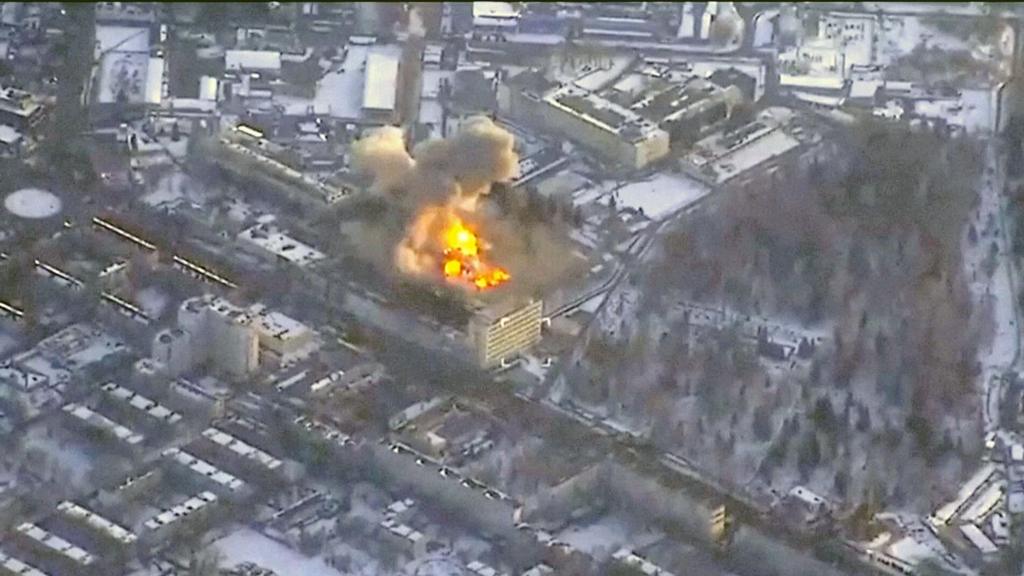
Ukrainian forces have struck a significant blow against Russian military infrastructure, according to intelligence sources in Kyiv confirmed on Thursday. The target was a plant producing critical components for missile systems, located in the Smolensk region of western Russia. The attack, carried out using long-range drones, marks a new phase in Ukraine's ability to project force beyond the front lines and directly impact the logistical and production chain of the Russian military-industrial complex.
The context of this operation fits within a sustained campaign by Ukraine to degrade Russia's capacity to produce and launch cruise and ballistic missiles, which have been used extensively against Ukrainian civilian and energy infrastructure in recent months. The plant in Smolensk, according to Western intelligence analyses cited by specialized media, is involved in manufacturing guidance systems and electronic components for missiles such as the Kh-101, Kalibr, and Iskander ballistic missiles. Disrupting this supply chain could have a tangible impact on the frequency and volume of Russian missile attacks in the near future.
Relevant data provided by the Strategic Communications Center of the Armed Forces of Ukraine indicates the attack occurred in the early morning hours and employed several drones. Satellite images not independently verified, but circulated by open military channels, show columns of smoke rising from the industrial complex. Although the Russian Defense Ministry claimed to have intercepted "several drones" in the Smolensk region, it made no specific mention of damage to industrial facilities. This discrepancy is common in the war information narrative from both sides.
"Our objective is clear: to reduce the capacity of the terrorist Russian state to produce weapons with which it kills Ukrainian civilians," declared a senior official from Ukraine's Security Service (SBU) under condition of anonymity to Reuters. "Every component that does not reach a missile is a life potentially saved," he added. For his part, Kremlin spokesman Dmitry Peskov labeled the attack as "an act of terrorist desperation" and promised that "all consequences for the organizers and perpetrators will be inevitable."
The strategic impact of this type of operation is multifaceted. In the short term, it aims to create bottlenecks in the production of Russian precision weaponry, forcing Moscow to rely more on stored reserves or lower-quality components from partners like Iran or North Korea. In the medium term, the campaign forces Russia to disperse and reinforce security at its military industrial installations, a considerable logistical and financial effort. Finally, on a psychological and political level, it demonstrates to the Russian population that the war has a direct cost on their territory and undermines the official narrative that the conflict is being fought far from Russian borders.
In conclusion, the attack on the component plant in Smolensk represents a tactical evolution in Ukraine's defense strategy, which has moved from a purely reactive posture to one that includes deep interdiction operations. While a single attack is unlikely to radically alter the course of the war, it is another element within a systematic campaign to erode Russia's quantitative military advantage. The real effectiveness of this strike will only be measurable in the coming weeks, by observing whether there is a notable decrease in the number or accuracy of Russian missile attacks against Ukraine. Meanwhile, the escalation in attacks behind enemy lines confirms that the conflict is far from stagnant and continues to expand in its geography and the methods employed.