This February 14th, as couples exchange chocolates and roses, cinephiles commemorate a different anniversary: the enduring legacy of 'Crouching Tiger, Hidden Dragon' as one of cinema's greatest epic love stories. Directed by Ang Lee and released in 2000, the film transcended the martial arts genre to weave a deeply romantic and tragic narrative that, 24 years later, continues to resonate for its exploration of desire, duty, and sacrifice. More than a mere 'wire-fu' action movie, it became a global cultural phenomenon, winning four Academy Awards and opening the doors of wuxia cinema to Western audiences.
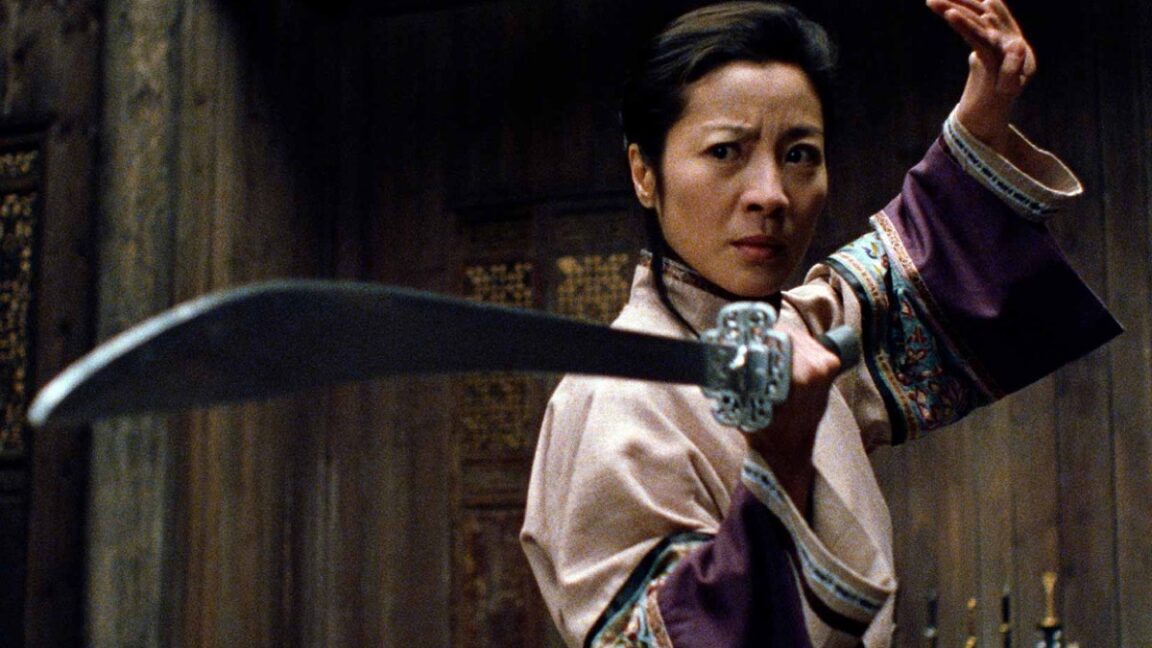
The film's context is crucial to understanding its impact. In the late 1990s, Chinese martial arts cinema was primarily appreciated by connoisseurs. Ang Lee, already an acclaimed director for 'Sense and Sensibility' and 'The Ice Storm,' wanted to make a film that honored wuxia traditions but infused them with unprecedented emotional depth and visual elegance. Set in the Qing dynasty, the story centers on the quest for the legendary sword 'Green Destiny,' but its true heart beats in the relationships between its characters. The unconsummated romantic tension between master warriors Li Mu Bai (Chow Yun-fat) and Yu Shu Lien (Michelle Yeoh) provides an adult, restrained melancholy, while the passionate, rebellious romance between young aristocrat Jen Yu (Zhang Ziyi) and the bandit Lo 'Dark Cloud' (Chang Chen) offers a contrast of youthful fire.
Relevant data underscores its revolutionary success. With a budget of approximately $15 million, the film grossed over $213 million worldwide, becoming the highest-grossing non-English language film in history at the time. Its triumph at the 2001 Oscars, where it won Best Foreign Language Film, Best Cinematography (Peter Pau), Best Original Score (Tan Dun), and Best Art Direction, was a milestone for Asian cinema. The soundtrack, with its main theme 'A Love Before Time' (Oscar-nominated) performed by CoCo Lee, and the virtuosity of cellist Yo-Yo Ma, became a symbol of its ethereal romanticism.
Statements from the cast and creative team over the years have illuminated the romantic intent. Ang Lee has said in interviews: "I wanted to make a film about repressed love, about emotions that cannot be openly expressed due to honor and society. The choreography of the fights is, in essence, a choreography of that desire." Michelle Yeoh reflected on her character: "Shu Lien is strong, but her strength comes from enduring the pain of a love that could never bloom. It's a very deep and sad kind of love." Zhang Ziyi, in turn, described Jen's arc as "the story of a young woman who believes love and freedom are the same thing, and who discovers that sometimes the price of both is higher than she imagined."
The impact of 'Crouching Tiger, Hidden Dragon' is multifaceted. Aesthetically, it redefined expectations for martial arts cinema, prioritizing poetic grace and emotion over pure spectacle, influencing a generation of filmmakers. Culturally, it presented strong, complex female archetypes in lead roles, something still rare in blockbusters of the era. As a love story, it offered a mature narrative that avoided simplistic happy endings, presenting instead a romance that was as much about loss and loyalty as it was about passion. Its final scene, with Jen leaping from Wudang Mountain, remains one of cinema's most ambiguous and debated moments, interpreted as an act of liberation, despair, or amorous transcendence.
In conclusion, this Valentine's Day, 'Crouching Tiger, Hidden Dragon' deserves to be remembered not only as a cinematic milestone or a martial arts film, but as a masterpiece of tragic romance. Its enduring power lies in its ability to intertwine the most spectacular physical action with the most delicate emotional restraint. The film reminds us that the greatest battles are often fought in the heart, and that love, in both its repressed and explosive forms, is a force as powerful and transformative as any martial art. Two decades later, Li Mu Bai's question to Shu Lien – "Do you think we have already wasted too much time?" – remains a heartbreakingly relevant echo for any era, cementing its place in the canon of great cinematic romances.