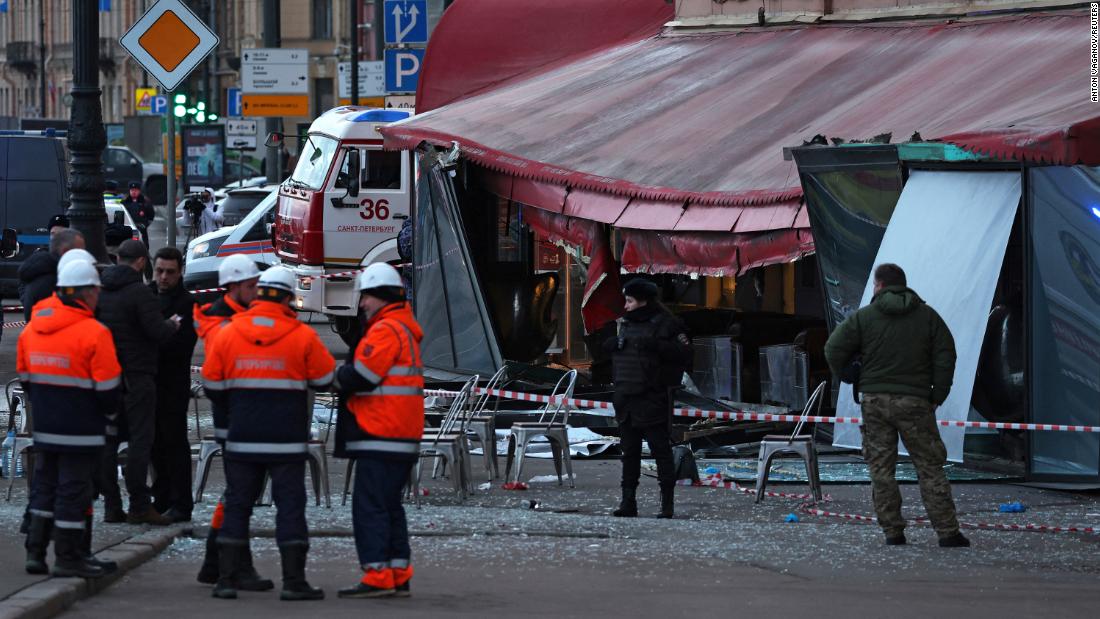
Security footage, widely circulated by Russian state media, shows the precise moment a powerful explosion rocked a popular cafe in the historic center of St. Petersburg, leaving at least one person dead and more than two dozen injured. The graphic images capture the moment a figure, identified by authorities as a woman, approaches a table on the establishment's terrace before a detonation envelops the area in a cloud of smoke and debris. The attack, which occurred on Universitetskaya Naberezhnaya street, on the banks of the Neva River and near prestigious university faculties, has shocked Russia's second most important city.
The context of this incident falls within a period of heightened tension in Russia, marked by the war in Ukraine and a series of internal attacks attributed by the Kremlin to Ukrainian forces or nationalist elements. Russian authorities have classified the event as a terrorist act. According to Russia's Investigative Committee, the suspect, identified as Darya Trepova, 26, was arrested hours later in a city apartment. Preliminary investigations indicate the woman personally delivered a statuette containing the explosive device to Vladlen Tatarsky, an influential Russian military blogger and supporter of the offensive in Ukraine, who was fatally wounded on the spot. Tatarsky, whose real name is Maxim Fomin, was a prominent figure in patriotic communication circles, with hundreds of thousands of followers on his Telegram channel.
Relevant data indicates the explosion, which occurred around 6:00 p.m. local time, not only caused the blogger's death but also injured 32 people, according to the latest report from the Russian Ministry of Health. Six of the injured are in serious condition. The device, according to security sources cited by the TASS agency, contained the equivalent of more than 200 grams of TNT and was loaded with shrapnel to maximize damage. The cafe, called 'Street Food Bar No. 1', was a venue frequented by public figures and journalists, and that day was hosting an event organized by a paramilitary group. The rapid dissemination of the video through official channels aims, according to analysts, to reinforce the state narrative about the terrorist threat.
So far, there has been no official claim of responsibility for the attack. However, a Telegram channel associated with the Wagner paramilitary group, whose leader Yevgeny Prigozhin owned the cafe until last year, published a statement attributing the attack to 'radical activists' linked to the Russian opposition in exile. For its part, Kremlin spokeswoman Maria Zakharova stated: 'The response will be severe. The organizers of this crime will not escape punishment.' Meanwhile, from Ukraine, presidential adviser Mykhailo Podolyak denied any involvement by Kyiv, calling the incident an 'internal struggle of radical groups' within Russia.
The impact of this attack is multifaceted. On the security front, it highlights internal vulnerabilities in major Russian cities despite the strong intelligence apparatus. Socially, it deepens the climate of fear and uncertainty among the civilian population, already living under the shadow of conflict. Politically, it serves the government to justify greater repression against dissent under the umbrella of the fight against terrorism. Furthermore, the death of a pro-war media figure like Tatarsky represents a symbolic blow to the Kremlin's propaganda machinery, which relies on these 'trench bloggers' to mobilize public support.
In conclusion, the explosion at the St. Petersburg cafe is not an isolated event but a symptom of the violence internalizing within Russian society after more than a year of war. The video capture of the attack's moment not only documents a tragedy but becomes an instrument in the narrative battle between the state and its enemies, real or perceived. As investigations continue, the incident leaves open questions about the ability of various actors to carry out attacks in the heart of Russia and about the future of security in the country, which seems to be entering a new and dangerous phase of internal confrontation.