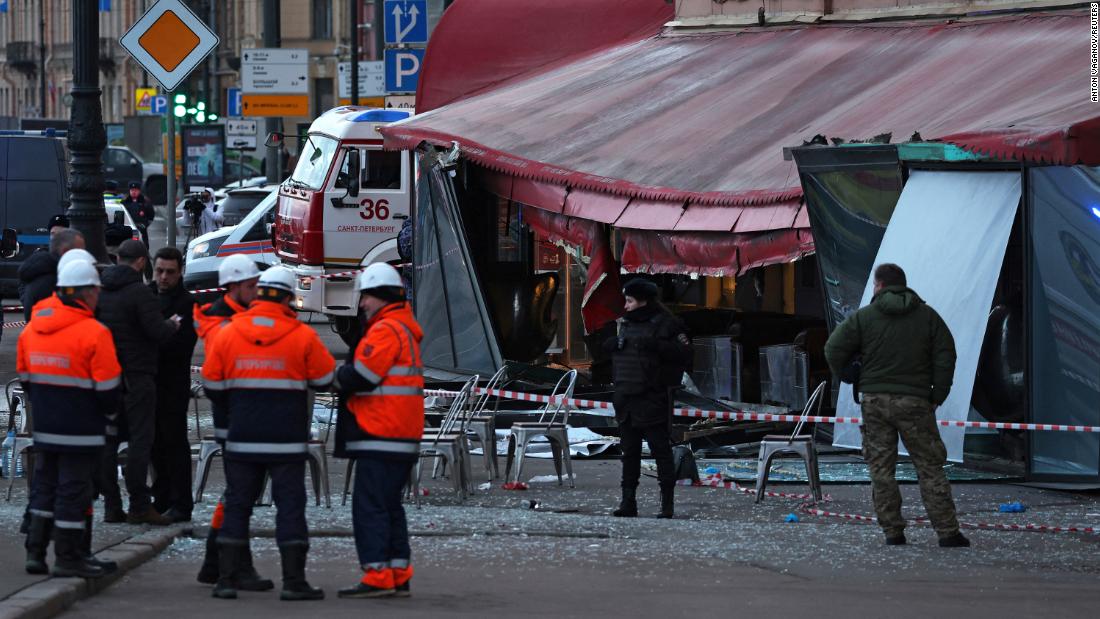
A violent explosion rocked a cafe in the historic center of St. Petersburg, Russia, on Sunday, in an attack authorities are calling a terrorist act that killed Vladlen Tatarsky, a prominent Russian military blogger and nationalist with a vast online following. The incident, which also injured more than 30 people, occurred during an event organized by a pro-Russian activist group at the Street Food Bar No. 1 cafe, located on Universitetskaya Street near the State University. Video footage circulating on social media and verified by international media shows the precise moment of the detonation: a powerful blast that shatters the cafe's interior, sends tables and chairs flying, and fills the room with smoke and debris as attendees flee in panic.
Vladlen Tatarsky, whose real name was Maxim Fomin, was a prominent figure in the Kremlin-aligned media ecosystem, with over half a million followers on Telegram. Known for his openly belligerent stances and his support for Russia's invasion of Ukraine, Tatarsky had gained notoriety for his military analysis and his occasional criticism of the Russian high command's conduct of the war. The Russian Interior Ministry confirmed his death and opened a murder and terrorism investigation. According to preliminary reports from Russian news agencies TASS and RIA Novosti, citing security sources, the explosive device is believed to have been delivered to the blogger in the form of a statuette during the event, in what appears to be a targeted and meticulously planned attack.
This attack occurs in a context of rising tension within Russia, marked by a series of sabotage incidents and attacks against figures aligned with the government and the war's hardline stance. This episode evokes the assassination of Daria Dugina, daughter of ultranationalist ideologue Alexander Dugin, in a car bombing on the outskirts of Moscow in August 2022, which Russian authorities blamed on Ukrainian services. So far, no group has claimed responsibility for the St. Petersburg attack. However, Russia's National Anti-Terrorism Committee (NAK) quickly pointed the finger at Ukraine and its intelligence services, as well as internal opponents linked to imprisoned opposition leader Alexei Navalny, accusations that Kyiv has categorically denied. A spokesperson for Ukraine's Security Service (SBU) told media: "We are waging a defensive war on our territory, we do not organize murders in cafes in St. Petersburg."
The impact of the attack transcends the human loss. Symbolically, it represents a direct blow to the heart of the nationalist and bellicose discourse that has dominated the Russian media space since the start of the full-scale invasion. Tatarsky was a voice that legitimized the war for a mass audience, and his elimination sends a chilling message about the vulnerability of these public figures, even in the center of Russia's second most important city. The official reaction has been one of unanimous condemnation. Kremlin spokesperson Dmitry Peskov called the attack a "barbaric terrorist act" and stated that security forces are working at full capacity. Meanwhile, the mayor of St. Petersburg, Alexander Beglov, expressed his condolences to the victims' families and promised support for the injured.
The explosion also raises serious questions about internal security in Russia's major cities, at a time when the conflict in Ukraine enters its second year with fierce intensity. Political analysts suggest the incident could be used to justify a new escalation of repressive measures and control within the country, under the pretext of combating terrorism and enemy infiltration. For Tatarsky's followers and the community of military bloggers, his death is a significant loss of a voice that, although controversial, was considered authentic and well-informed. The attack at the Street Food Bar No. 1 cafe is not just an isolated act of violence; it is a symptom of a war that, far from being confined to the battlefields of Ukraine, is beginning to reverberate with unpredictable consequences on Russian soil, blurring the lines between the front line and the home front, and sowing a climate of fear and uncertainty.