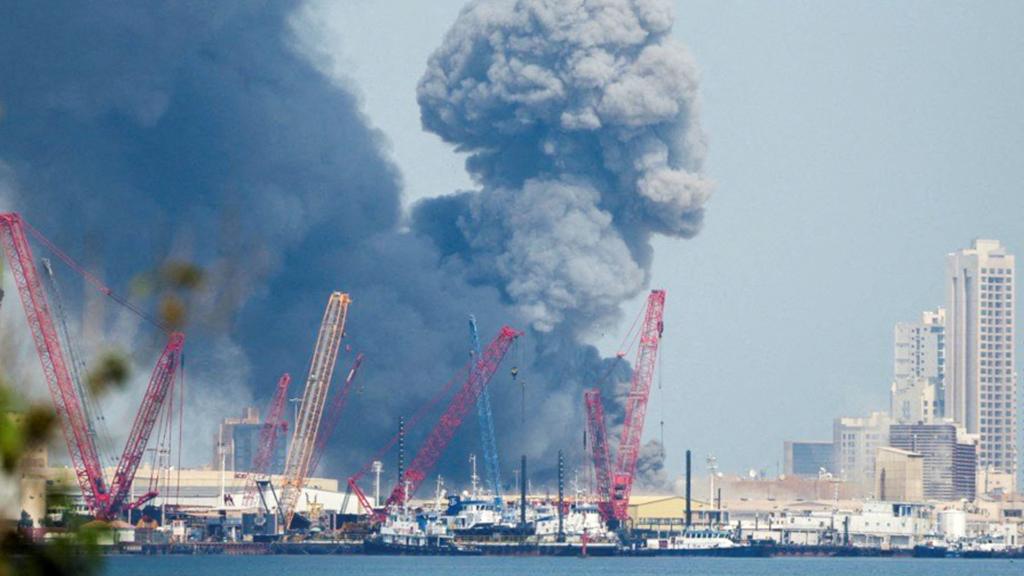
In a dramatic escalation of Middle East tensions, Iran announced on Tuesday that its forces have struck a US military base located in Bahrain, as part of a series of retaliatory operations launched against targets across the region. The announcement, made by the Islamic Revolutionary Guard Corps (IRGC) through Iranian state media, comes amid a growing confrontation between Tehran and Washington, as well as a broader regional conflict involving Iran-aligned groups. Iranian statements claim the strikes were a direct response to what they describe as "ongoing aggressions" by the United States and Israel, specifically mentioning the recent assassination of an IRGC commander in Syria, attributed to Israel.
The context for this action is extremely complex and dangerous. The region was already on the brink following attacks by the Iran-backed Houthi group from Yemen on shipping in the Red Sea, and near-daily exchanges of fire between the Lebanese militia Hezbollah and Israel on the northern border. The claim of a direct attack on a US facility on allied soil, such as Bahrain, home to the US Navy's Fifth Fleet, represents a significant qualitative leap. Until now, clashes between Iranian and US forces have been largely indirect, fought through proxy militias. A direct, claimed attack by the IRGC on a major US base would cross a red line both sides had carefully avoided.
So far, US and Bahraini authorities have not confirmed the reported attack. A Pentagon spokesperson, contacted by news agencies, stated, "We are aware of the reports and are assessing the situation," declining further comment. For its part, Bahrain's Ministry of Foreign Affairs issued a statement condemning "any aggression against its sovereignty" and stating that its air defense is on maximum alert, without explicitly confirming or denying an impact. Regional security analysts warn that, if verified, this would be one of Iran's most audacious attacks on US interests in years, with the potential to trigger a massive military response from Washington.
Official Iranian statements were blunt. IRGC Commander Hossein Salami stated on state television: "The hand of our strategic power can reach any enemy base that threatens the security of the Islamic Republic. Today, we have demonstrated that capability. Our message is clear: no aggression will go unanswered." Simultaneously, Iran's Foreign Ministry issued a diplomatic note warning the United States against any further action, arguing that its country "exercises its legitimate right to defense" within the framework of the UN Charter. These statements contrast with the Western narrative, which accuses Iran of fueling regional instability by funding and arming militias in Iraq, Syria, Yemen, and Lebanon.
The impact of this announcement is immediate and far-reaching. Global markets reacted nervously, with Brent crude oil prices rising over 3% in Asian trading, surpassing $84 per barrel, on fears of a supply disruption in the Strait of Hormuz. International airlines have already begun diverting routes that fly over Persian Gulf airspace. Diplomatically, the foreign ministries of major powers, including Russia, China, and European nations, have issued urgent calls for "maximum restraint." The Arab League convened an emergency meeting, while the UN Security Council could hold a closed-door session in the coming hours at the request of the United States or its allies.
In conclusion, Iran's claim to have struck a US base in Bahrain marks an extremely dangerous turning point in the already volatile Middle East situation. Regardless of the military verification of the event, the declaration itself is a calculated act of defiance aimed at altering the deterrence calculus with Washington. The world watches with apprehension to see if this incident will lead to a spiral of direct reprisals between two military powers, with the inherent risk of open conflict. The international community now faces the urgent challenge of exercising effective crisis diplomacy to lower temperatures and prevent a spark in the Gulf from igniting a regional fire of unpredictable proportions.