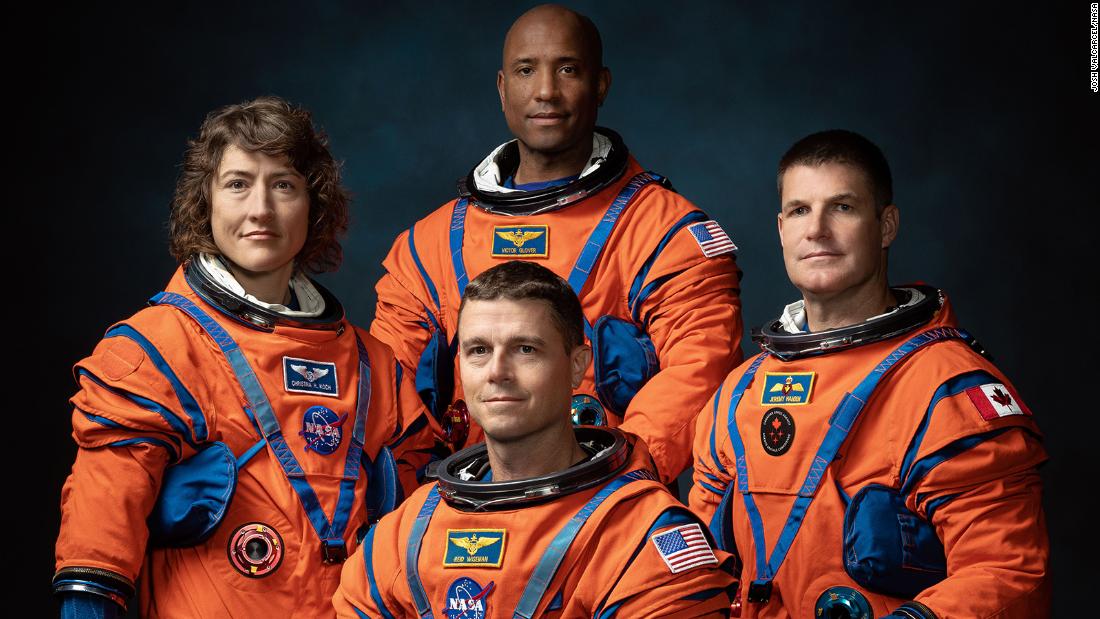
NASA has taken a historic step toward humanity's return to the Moon by introducing the four astronauts who will crew the Artemis II mission, the first crewed lunar spaceflight in over five decades. The announcement, made on Monday from Johnson Space Center in Houston, Texas, marks the start of intensive training for the crew, scheduled to launch in November 2024. The Artemis II mission will not land on the Moon but will perform a lunar flyby, orbiting our natural satellite and paving the way for the subsequent Artemis III Moon landing.
The crew is a mix of veterans and rookies, reflecting the diversity and experience of the new American space age. Commanding the mission will be astronaut Reid Wiseman, a U.S. Navy veteran with a previous mission to the International Space Station (ISS). As pilot, NASA has selected Victor Glover, who made history as the first African American pilot on a long-duration ISS mission during SpaceX's Crew-1. The two mission specialists are Christina Hammock Koch, who holds the record for the longest single spaceflight by a woman (328 days), and Jeremy Hansen, an astronaut from the Canadian Space Agency (CSA), making Artemis II an international mission. Hansen's inclusion underscores Canada's key role, as it contributes the Canadarm3 robotic arm to the lunar Gateway program.
The context for this announcement is NASA's ambitious Artemis program, whose ultimate goal is to establish a sustainable presence on the Moon and use the knowledge gained as a stepping stone for future missions to Mars. Artemis I, an uncrewed mission that tested the SLS rocket and Orion capsule, was successfully completed in December 2022 after a 25-day journey around the Moon. Artemis II will be the first crewed test of the SLS/Orion system, a crucial milestone for verifying life support systems and deep space operations. The data collected will be vital for the design and execution of Artemis III, which aims to land the first woman and the first person of color on the lunar surface.
Statements during the event were filled with emotion and a sense of history. "For all of us at NASA, this is a great day. We have a lot to celebrate," said NASA Administrator Bill Nelson. Astronaut Jeremy Hansen, addressing the audience, highlighted the collective effort: "We are not going to the Moon. We, as humanity, are going to the Moon. And this international crew will represent all of humanity." Meanwhile, Christina Koch expressed her hope to inspire a new generation: "It is an honor and a responsibility. We hope to carry the dreams of millions of people with us around the Moon."
The impact of this designation is multifaceted. On a technical level, it initiates an rigorous 18-month training program that will include mission simulations, emergency preparedness, and familiarization with every system of the Orion spacecraft. Geopolitically, it reinforces U.S. leadership in space exploration and strengthens international cooperation, with Canada, Europe, and Japan as key partners in the Artemis program. Socially, the diversity of the crew sends a powerful message of inclusion, demonstrating that deep space exploration is an endeavor for all of humanity.
In conclusion, the revelation of the Artemis II crew is not just the assignment of four names to a mission; it is the materialization of a vision that has been in development for years. It marks the point where paper plans and hardware tests give way to concrete human preparation for a journey beyond low Earth orbit for the first time since 1972. The success of Artemis II will be the cornerstone upon which the entire future of sustainable lunar exploration is built. The world will watch as these four explorers begin their training, carrying the legacy of Apollo and the responsibility of opening the next frontier for humanity.