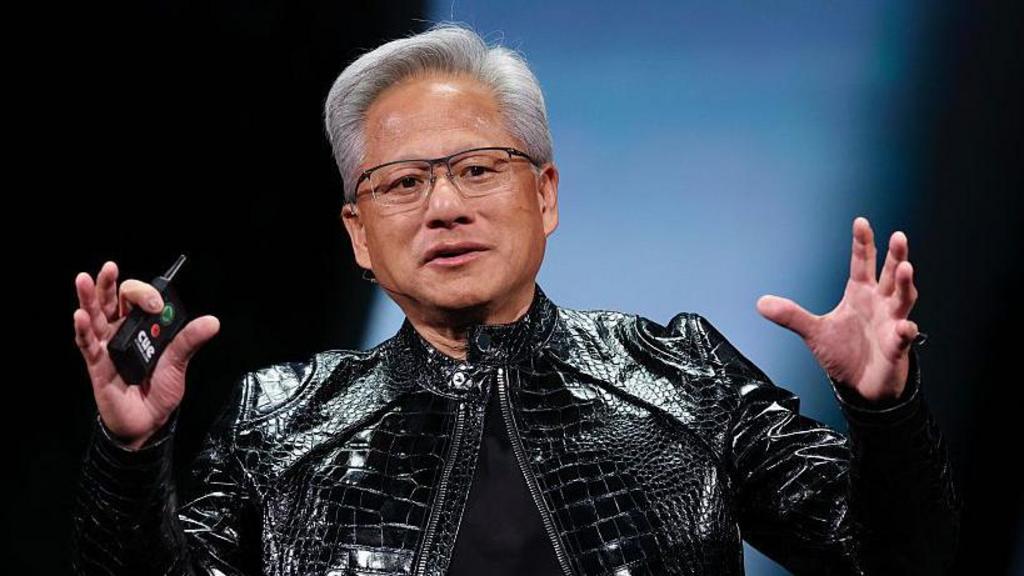
In a show of force that temporarily silences skeptics, Nvidia Corporation has announced record revenue exceeding $215 billion for its latest fiscal year. This monumental result, driven almost entirely by the insatiable demand for its graphics processing units (GPUs) for artificial intelligence applications, comes at a time of intense global debate about the limits, regulation, and potential risks of AI technology. The company, which has evolved from a graphics specialist for video games to the cornerstone of global AI infrastructure, demonstrates that the business momentum of the sector currently outweighs the ethical and existential concerns surrounding it.
The context for this achievement is an unprecedented technological race. Companies like Microsoft, Google, Meta, and Amazon, along with a legion of startups and research centers, are competing to develop and deploy increasingly powerful generative AI models. These models require massive computing power, precisely the domain where Nvidia's GPUs, especially its Hopper architecture and the new Blackwell, are irreplaceable. CEO Jensen Huang has called this moment "the new dawn of computing," where AI acceleration is redefining entire industries. The data is eloquent: Nvidia's data center segment, which houses these AI sales, grew over 400% year-over-year, completely overshadowing its traditional gaming business.
However, this dizzying success unfolds against a backdrop of growing apprehension. Tech leaders, scientists, and regulators have repeatedly expressed concern about the dangers of uncontrolled AI, ranging from the proliferation of misinformation and automated cyberattacks to theoretical long-term risks for humanity. Several governments are drafting regulatory frameworks, such as the European Union's AI Act, seeking to set development boundaries. In recent statements, Huang addressed this contrast: "AI is the most transformative technology of our generation. It carries enormous responsibilities, and at Nvidia we are working to provide the tools that enable safe and beneficial development. Our role is to empower researchers and companies to innovate responsibly." This stance attempts to balance commercial optimism with a formal acknowledgment of the challenges.
The impact of Nvidia's results transcends its own finances. Its stock, which has multiplied in value in recent years, acts as a barometer for the entire tech sector and stock markets. Nvidia's health influences investment decisions in AI startups, the R&D budgets of big tech companies, and the geopolitical strategies of countries seeking semiconductor sovereignty. The success consolidates the critical dependence of the digital economy on a highly specialized chip supply chain, concentrated in a few companies and geographies, posing security and resilience risks.
In conclusion, Nvidia's revenue record represents a fork in the narrative of AI. On one hand, it confirms that the artificial intelligence revolution is a tangible, large-scale economic phenomenon with a clear hardware engine. On the other, it accentuates the paradox of technological progress advancing at a pace far exceeding that of ethical reflection and global governance. The near future will depend on whether the industry, incentivized by profits like Nvidia's, can self-regulate effectively or whether, conversely, the gap between technical capability and social control will lead to stricter regulatory intervention that could eventually cool the very market it is currently overheating. For now, Wall Street's message is clear: the AI train is not stopping.