At the heart of every winter sports competition at the Olympic Games lies a surface that is far more than frozen water: Olympic ice. This seemingly simple sheet is the result of sophisticated engineering, materials science, and a craftsman's knowledge, all aimed at creating the perfect conditions for peak athletic performance. Unlike the ice at a public rink or a frozen pond, Olympic ice is a product of precision, engineered to be faster, harder, and more consistent, capable of withstanding the turns, jumps, and stops of the world's finest athletes. Its creation is a meticulous process that begins long before the first skater sets foot on the rink.
The process starts with the base, typically a concrete slab housing an intricate network of pipes. Through these pipes flows a refrigerant solution, usually a brine or glycol, kept at extremely low temperatures, often between -8 and -10 degrees Celsius for figure skating, and even colder, down to -6 or -7 degrees, for hockey, where a harder, faster surface is preferred. Onto this frigid base, water is applied layer by layer. This is where technique becomes crucial. The operators, colloquially known as "Zamboni drivers" but technically ice maintenance specialists, spray thin layers of purified, deionized water. The use of purified water is critical, as minerals found in tap water would create a softer, cloudier surface prone to chipping and cracking. Each layer freezes almost instantly upon contact with the icy base, forming a thin, solid sheet.
Dozens of these layers may be applied until a total thickness of approximately 1.5 to 2 inches (3-5 cm) is achieved. The arena's air temperature is another critical factor, typically maintained between 55 and 60 degrees Fahrenheit (13-16°C) for spectator comfort, but this layer of warmer air above the cold ice creates a microscopic film of water on the surface, known as a "pre-melt film." It is this microscopic film that reduces friction and allows for the fluid, high-speed glides of skaters. For long-track speed skating, the science is similar, but the sheet is vastly larger, and ice quality is meticulously measured to ensure perfect uniformity across every lane, guaranteeing fairness in competition.
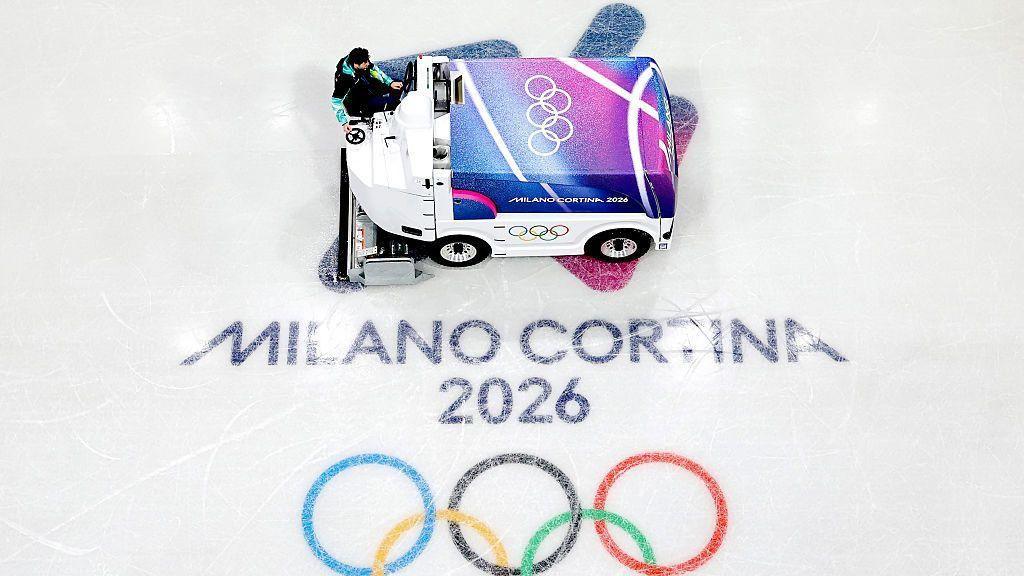
The white paint we see on hockey rinks and sometimes in figure skating is not paint in the traditional sense. Before applying the final layers of clear ice, the frozen base is coated with a mixture of water and white pigment, creating the bright background that enhances contrast for players, skaters, spectators, and television cameras. The lines and logos are then applied underneath additional layers of clear ice, becoming encapsulated and protected. Maintenance between game periods or between skaters is a ceremony in itself. The Zamboni machine scrapes the top surface, removing blade marks and resulting snow, washes the surface, and deposits a new, thin layer of hot water that flattens and freezes to create a renewed, perfectly smooth sheet.
The impact of ice quality on performance is profound. Ice that is too soft can "grab" skate blades, making turns harder and slowing skaters down. Ice that is too hard and cold can be brittle and increase the risk of injury. Elite athletes are acutely sensitive to these variations. "You can feel the difference on the first stride," an Olympic speed skater once remarked. "Perfect ice feels like gliding on silk; it gives you the confidence to push your limits." For figure skating jumpers, the consistency and hardness of the ice at the take-off point are critical for successful rotation and landing.
In conclusion, Olympic ice is a marvel of modern engineering and a testament to the human pursuit of perfection in sport. Far from a simple frozen surface, it is a dynamic, carefully controlled system representing the intersection of physics, chemistry, and athletic passion. Its creation requires a dedicated team of technicians working tirelessly, often on overnight shifts, to ensure that when Olympic athletes perform at their peak, they do so on a canvas worthy of their excellence. It is the silent but fundamental stage upon which the stories of glory and perseverance in every Winter Olympic Games are written.