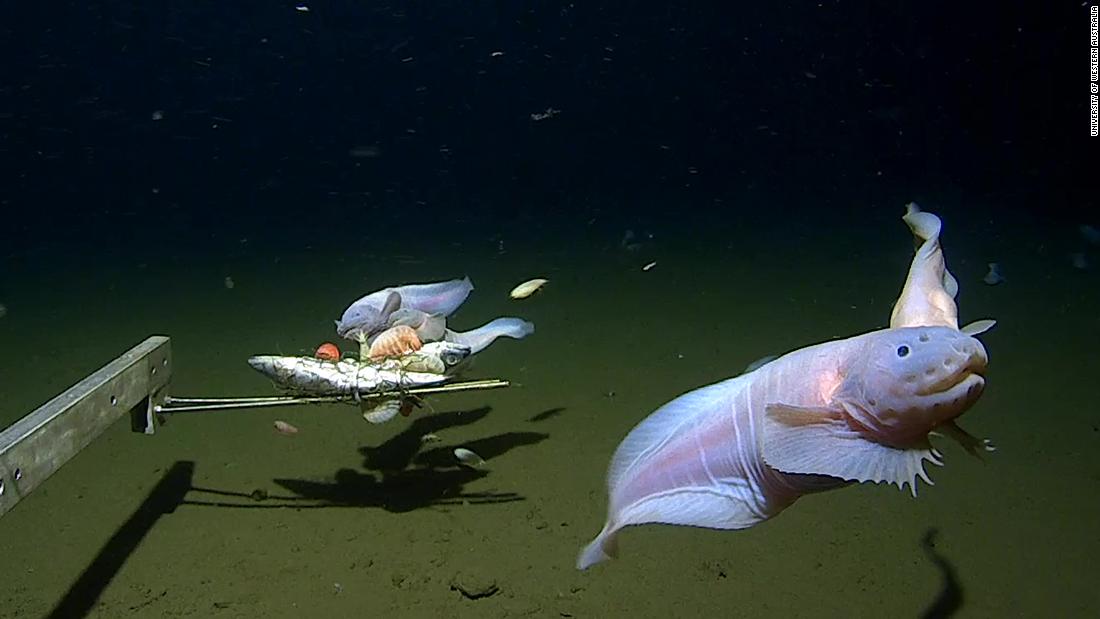
In an expedition that has redefined the boundaries of known life, an international team of scientists has successfully filmed a fish at an unprecedented depth of 8,336 meters in the Kuril-Kamchatka Trench, northeast of Japan. The creature, identified as a juvenile snailfish (from the Liparidae family), was recorded gliding with apparent ease just meters above the seabed, in a zone of abyssal pressure and perpetual darkness. This discovery, made during the *Hadal* expedition organized by the University of Western Australia and the Japan Agency for Marine-Earth Science and Technology (JAMSTEC), surpasses the previous record for filming a fish, set in 2017 in the Mariana Trench at 8,178 meters. The feat not only establishes a new milestone in marine biology but also offers crucial clues about the physiological limits of vertebrate life on our planet.
The context of this discovery lies within the exploration of the hadal zone, the deepest part of the ocean comprising trenches below 6,000 meters. These regions, representing 45% of the ocean's total depth, are among the least explored environments on Earth, subjected to pressures over 800 times greater than at sea level, temperatures near freezing, and a complete absence of sunlight. The expedition used specially designed remotely operated vehicles (ROVs), equipped with ultra-high-definition cameras and pressure-resistant lighting systems. The snailfish was sighted during a dive by the ROV *Ulysses*, which descended into the depths of the trench, a tectonic subduction zone where the Pacific Plate dives beneath the Okhotsk Plate.
The data collected is revealing. The filmed specimen is a juvenile, with an almost translucent pale white color, a gelatinous body, and delicate fins. Its presence at such depth suggests that these trenches are not biological deserts but active ecosystems where snailfish have developed extraordinary adaptations. Scientists note that these fish lack swim bladders, have poorly calcified skeletons, and bodies rich in osmotic compounds like trimethylamine N-oxide (TMAO), which helps them counteract the hydrostatic pressure that would crush most organisms. 'Seeing this fish thriving at over 8,300 meters forces us to reconsider the limits of vertebrate adaptation,' stated Professor Alan Jamieson, chief scientist of the expedition. 'It's not just a depth record; it's a window into how life conquers the most hostile environments.'
The implications of this discovery are profound for multiple fields. In evolutionary biology, it reinforces the theory that snailfish are the dominant vertebrates in hadal zones, possibly due to their physiological flexibility. In astrobiology, it offers an analog for considering the possibility of life on extraterrestrial ocean worlds, such as Europa (moon of Jupiter) or Enceladus (moon of Saturn), where similar conditions might exist under thick ice sheets. Furthermore, the finding underscores the urgency of exploring and conserving these deep ecosystems before human activities like deep-sea mining could irreversibly alter them. The Kuril-Kamchatka Trench, though remote, is not exempt from anthropogenic pressures.
In conclusion, the filming of this snailfish at 8,336 meters marks a historic moment in oceanography. It is not merely about breaking a record; it is a tangible demonstration of life's resilience and a reminder of how much we still do not know about the depths of our own oceans. Each expedition to these hadal regions unveils secrets that challenge our understanding of biology and open new frontiers for science. This small fish, swimming in eternal darkness, has become a symbol of the mysteries lying in Earth's final frontiers, urging us to continue exploring with humility and curiosity.