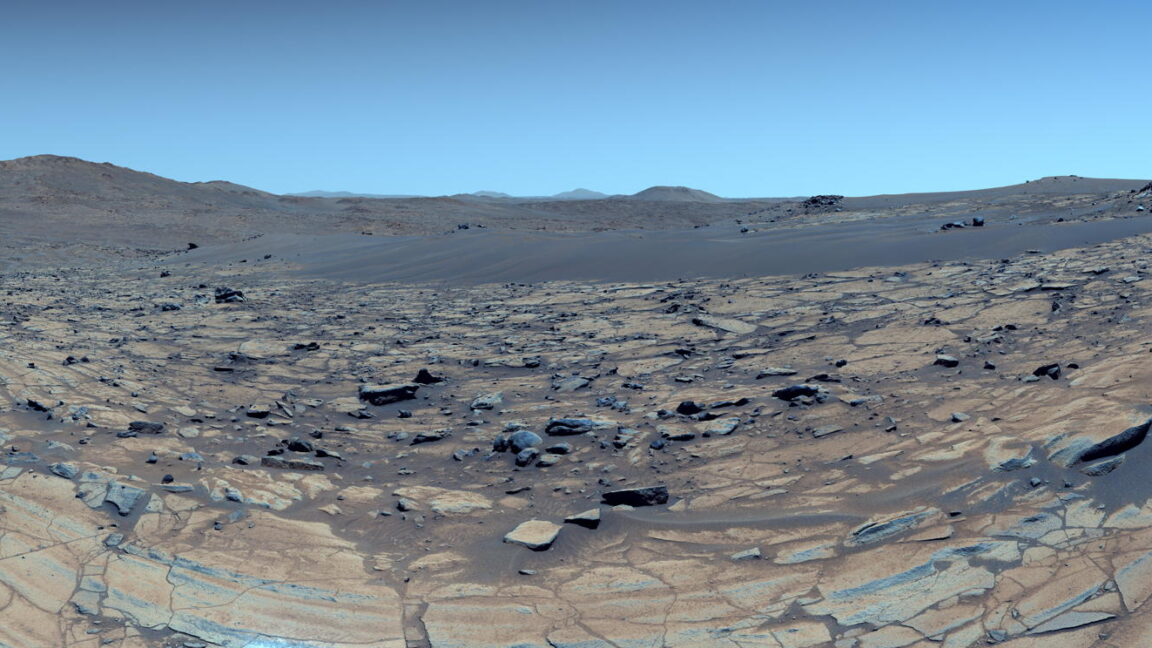
A new analysis of geological data is upending prevailing theories about the early climate of Mars, suggesting the Red Planet may have been significantly warmer and wetter than believed, rather than a perpetually frozen world. For decades, the scientific community has hotly debated the environmental conditions of ancient Mars, with many climate models pointing to a mostly cold planet where liquid water would be scarce and transient. However, comprehensive research combining observations from orbiters, rovers, and improved climate models is painting a different picture: a Mars with extensive periods of temperate climate, capable of sustaining lakes, rivers, and perhaps even oceans.
The context of this debate dates back to the first images of the Martian surface, which unequivocally showed drainage channels, river deltas, and basins that could only form through the sustained action of liquid water. The challenge has always been reconciling these features with the 'Faint Young Sun' paradox. Billions of years ago, the Sun emitted roughly 30% less energy, which theoretically would make it impossible for Mars, farther from the Sun than Earth, to maintain temperatures above the freezing point of water. Models proposing a 'cold and icy' Mars suggested that liquid water episodes were brief, driven by asteroid impacts or extreme volcanism that temporarily released greenhouse gases.
The relevant data changing this narrative comes from multiple sources. NASA's Perseverance rover in Jezero Crater has confirmed the presence of clays and carbonate minerals that typically form in the presence of stable liquid water over long periods. Simultaneously, orbiters like the Mars Reconnaissance Orbiter have mapped clay deposits on a global scale, indicating an active hydrosphere. New climate models, incorporating effects from water-ice clouds, more extreme axial tilt (obliquity) cycles, and the possible periodic release of greenhouse gases like methane from the subsurface, demonstrate that episodic but prolonged warming is plausible. 'We are seeing that the 'cold and icy Mars' models struggle to explain the extent and mineralogy we observe,' stated Dr. Elena Vázquez, a planetary scientist at the Institute of Space Sciences. 'The geological evidence is overwhelming: we need periods of climate warm and wet enough for rivers to flow and lakes to persist for millennia.'
The impact of this reassessment is profound for astrobiology and our understanding of planetary habitability. If Mars experienced long eras with stable liquid water, the windows of time for life to emerge, had it existed, were much wider. Lake and delta environments are precisely the places where, on Earth, the earliest microbial fossils are found. This elevates the scientific potential of the samples Perseverance is collecting for future return to Earth. Furthermore, it reframes the history of Martian water: instead of being quickly lost to space or frozen in the subsurface, water may have been a dynamic element on the surface for a significant fraction of the planet's history.
In conclusion, although Mars is today a cold, arid desert, its past appears to have been remarkably more clement. The emerging view is not of a constantly warm planet like Earth, but of a world with dramatic climate cycles, alternating between ice ages and wet, relatively temperate interglacial periods. This paradigm of a 'dynamic and sometimes wet Mars' not only better fits the geological observations but also reinforces the idea that conditions for life can arise and persist on worlds beyond our own, even under a fainter star. The next step will be to refine these models with more surface data and, ultimately, to analyze Martian rocks in terrestrial laboratories to search for chemical traces of those ancient aquatic environments and, perhaps, of life itself.