In a surprising turn of events that defies the predictions of military and political analysts, the Islamist movement Hamas is reasserting its administrative and security control over significant parts of the Gaza Strip, despite having suffered devastating human and material losses during more than eight months of intense fighting with the Israel Defense Forces (IDF). This organizational resilience raises profound questions about Israel's strategy to dismantle the group and about the immediate future of the Palestinian territory, plunged into an unprecedented humanitarian crisis.
The Israeli military offensive, launched in response to the deadly October 7, 2023, attacks perpetrated by Hamas, had the declared objectives of freeing the hostages and demilitarizing and dismantling the group, considered a terrorist organization by Israel, the United States, and the European Union. The IDF has carried out massive air and ground operations, claiming to have eliminated thousands of Hamas fighters, including senior commanders, and to have destroyed or severely damaged an extensive network of underground tunnels, known as the "Gaza Metro." However, reports from the ground and intelligence analysis indicate that Hamas's command structure, although weakened, remains operational.
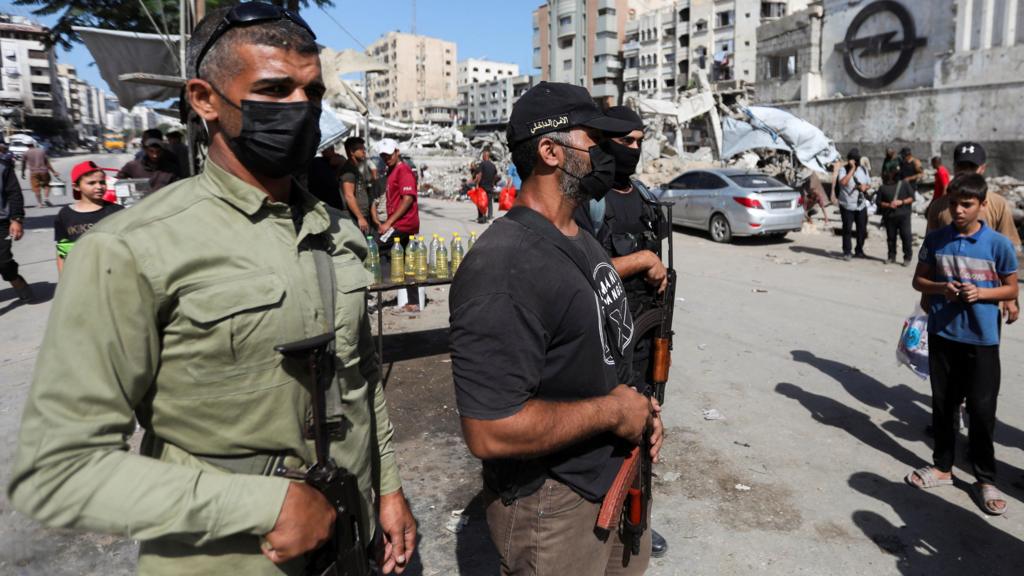
The reassertion of control is manifesting in several key areas. In zones of northern and central Gaza, where the IDF significantly reduced intensive combat operations, there have been reports of the reappearance of police and civil officials affiliated with Hamas's administration, tasked with maintaining a minimum of public order, distributing scarce aid, and collecting taxes. This resurgence of governmental authority, albeit limited, contrasts with the power vacuum and chaos Israel hoped to create. The movement's deep social and charity network, built over decades, appears to be playing a crucial role in this phase, providing a basic safety net for a desperate population.
Security experts underscore that Hamas's nature as a socio-political-religious movement, and not just a militia, is key to understanding its resilience. "Hamas is not just an army; it is a system of governance, an ideology, and an extensive network of social services," explains Middle East analyst Dr. Yossi Mekelberg. "As long as it maintains the support or acquiescence of a significant portion of the Gazan population, which is suffering the consequences of the war, it will be extremely difficult to eradicate its influence by purely military means." This assessment suggests that the Israeli campaign, despite its overwhelming firepower, may have underestimated the group's ability to adapt and reconstitute in the shadows.
The impact of this situation is multidimensional and deeply concerning. For Israel, it represents a potential strategic failure that could leave Hamas with the capacity to reorganize and pose a future threat, casting doubt on the official narrative of "total victory." For the civilian population of Gaza, trapped in the midst of violence, the re-emergence of some authority structure could bring fragile stability, but it also consolidates the control of the very group whose actions triggered the devastating Israeli response. For diplomatic efforts, led by Egypt, Qatar, and the United States, Hamas's continued strength complicates any viable plan for a "day after," as the group will fiercely resist being excluded from Gaza's future governance.
In conclusion, the war in Gaza has entered a critical and paradoxical phase. Although Hamas has been militarily decimated, its ability to reassert its administrative presence amid the ruin suggests that victory on the battlefield does not automatically translate into long-term political or security victory. The future of the territory seems doomed to continue in a limbo of destruction and latent conflict, unless a comprehensive political agreement is reached that addresses the root causes of the confrontation and establishes a legitimate and unified Palestinian authority capable of governing and rebuilding Gaza.