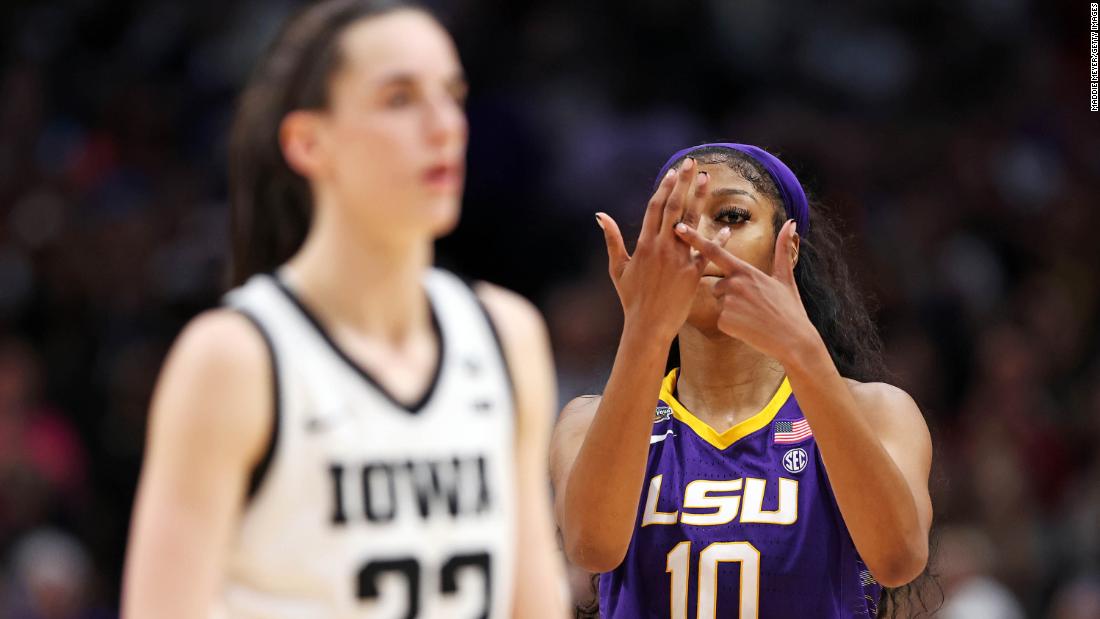
The world of American collegiate sports is embroiled in a heated debate following Louisiana State University's (LSU) victory in the NCAA women's basketball national championship. LSU star Angel Reese has become the focal point of controversy for a gesture she directed at opposing player Caitlin Clark of the Iowa Hawkeyes in the final moments of the game. Reese, who was named the Final Four's Most Outstanding Player (MOP), has forcefully responded to criticism, defending her action and calling out a double standard in the treatment of athletes, particularly Black women, in elite sports.
The incident occurred when, with the game decisively in LSU's favor, Reese followed Clark down the court and performed the "you can't see me" gesture in her face, moving her hand in front of her eyes, before pointing to her ring finger, alluding to a championship ring. This is a celebration popularized in sports culture, but its direct targeting of a specific opponent at a moment of clear superiority sparked an immediate and divided reaction. While some fans and pundits labeled it as unsportsmanlike and excessive, others defended it as a legitimate expression of emotion and competitive fire in the pinnacle moment of a college career.
In the post-game press conference and media statements, Angel Reese stood firm and "unapologetic." "I'm like that. I'm a fierce competitor. I don't take disrespect lightly," declared the 20-year-old forward. Reese explicitly linked the reaction to her gesture to the treatment of Black female athletes. "All year I was critiqued about what I do. I win, and now I'm critiqued for that. It's a double standard." The player referenced how Caitlin Clark, the nation's leading scorer and a white star, has performed similar celebratory gestures throughout the season and tournament, being praised for her "fire" and "swagger," while she is criticized for the same actions.
This episode transcends a mere in-game gesture and touches on sensitive nerves regarding race, gender, and performativity in sports. Women's college basketball is experiencing unprecedented visibility, with record TV ratings and sold-out arenas. In this context, the personalities of the players are magnified. Sports analysts and sociologists note that the debate reflects deep-seated stereotypes: the Black female athlete who shows confidence and flair is often perceived as "arrogant" or "defiant," while the white athlete who does the same is described as "passionate" and "self-assured." LSU coach Kim Mulkey backed her player, stating that Reese "plays with her heart on her sleeve" and that the gesture was a response to previous comments from Clark during the tournament.
The impact of this event is significant. On one hand, it has sparked a necessary national conversation about equity and perception in women's sports. On the other, it has projected Angel Reese as a symbol of a new generation of athletes who refuse to be pigeonholed and who demand the right to express their full personality, unfiltered. Social media is divided, with hashtags like #LetAngelBeAngel and #Sportsmanship trending, showcasing the deep rift in public opinion. For LSU, the victory and the controversy cement their return to the top of women's basketball. For the NCAA, the incident raises implicit questions about how it manages the narrative around its stars in an era of media hyper-exposure.
In conclusion, Angel Reese's defense is not just about a five-second gesture; it is a statement about autonomy, identity, and the right to celebrate success without having to conform to narrow expectations. Her call to recognize the double standard resonates far beyond the basketball court, in a sporting and social arena still grappling with equal treatment. As Reese and LSU enjoy their national title, the conversation they have triggered will likely have a more lasting impact than the game's final score, driving critical reflection on how we celebrate, critique, and ultimately see our female athletes.