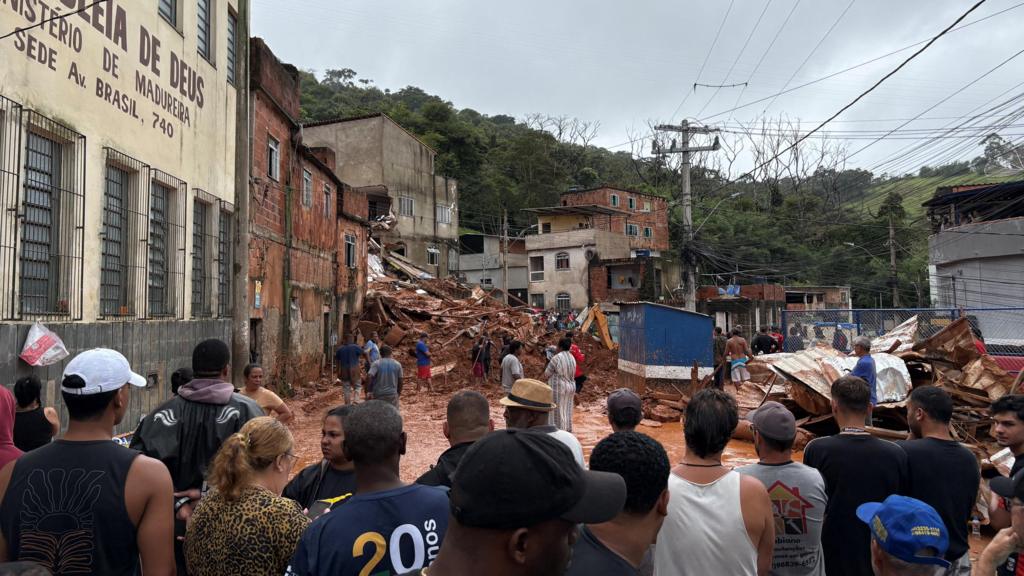
A series of intense torrential rains has triggered deadly flash floods and landslides in southern Brazil, claiming the lives of at least 20 people and leaving a trail of destruction across several communities. The rainfall, which has broken historical records for the season, has primarily affected the state of Rio Grande do Sul, where overflowing rivers have swept away entire neighborhoods and roads have been completely cut off. Local authorities declared a state of emergency in more than a dozen municipalities, mobilizing rescue teams from the fire department, civil defense, and armed forces to search for survivors and assist thousands of displaced people.
The context of this tragedy lies within an increasingly erratic climate pattern in the region, where extreme weather events have become more frequent and intense. Climatology experts point out that the combination of a stationary low-pressure system and the influence of warm, humid air currents from the Amazon created the perfect conditions for these exceptional rains. Data from the National Institute of Meteorology (INMET) indicates that some locations received over 300 millimeters of rain in less than 48 hours, an amount equivalent to the rainfall expected for an entire month. The mountainous topography of the region, coupled with disorderly urban occupation on high-risk slopes, amplified the impact of the landslides.
Among the most relevant data from the catastrophe, authorities confirmed at least 15 people are still missing, while the number of injured exceeds fifty. More than 5,000 residents have had to abandon their homes, taking refuge in temporary shelters set up in schools and municipal gyms. Critical infrastructure has also suffered severe damage, with reports of collapsed bridges, widespread power outages, and contamination of the drinking water supply. The state government estimates preliminary material damages to be in the hundreds of millions of reais, a figure that will likely increase as all affected areas are assessed.
Statements from authorities reflect the gravity of the situation. The governor of Rio Grande do Sul, Eduardo Leite, stated at a press conference: 'We are facing one of the greatest climate tragedies in our recent history. Our teams are working tirelessly, but the conditions are extremely difficult. We call for the solidarity of all Brazilians.' Meanwhile, the Minister of National Integration, Waldez Góes, highlighted that the federal government is already releasing emergency funds and sending heavy machinery to assist in debris removal and the restoration of traffic flow.
The impact of this natural disaster is profound and multifaceted. Beyond the loss of human life, which leaves dozens of families in mourning, the disruption to economic activity in the region is significant. Agriculture, a pillar of the local economy, has been severely harmed with flooded crops and livestock losses. Small shops and businesses were destroyed by water and mud, threatening the livelihood of many communities. Psychologists and social workers have been mobilized to provide support to the victims, many of whom lost everything they had in a matter of minutes.
In conclusion, the tragedy in southern Brazil serves as a grim reminder of the vulnerability of communities to extreme weather events, whose frequency and intensity are linked to global warming. As rescue teams continue their tireless work and the slow process of reconstruction begins, urgent questions arise about the need to strengthen early warning systems, review land-use policies and urban planning, and accelerate climate adaptation strategies. National solidarity has been evident with donations and volunteers, but the lesson is clear: preparing for the worst is no longer an option, but an imperative necessity to save lives in the future.