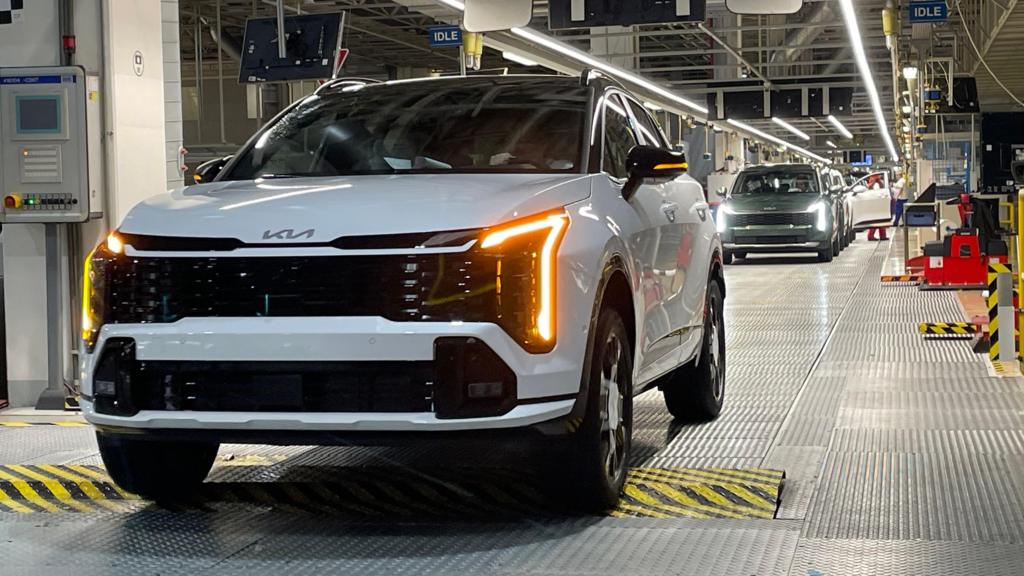
In the heart of Europe, a nation of just 5.4 million people has achieved an unprecedented industrial feat: becoming the world's largest car producer relative to its population. Slovakia, a country that emerged from the dissolution of Czechoslovakia in 1993, has transformed its economy into an automotive powerhouse that now manufactures over one million vehicles annually. This figure, which consistently surpasses the one-million-unit mark, means that for every Slovak inhabitant, approximately one car is produced—a ratio no other country can match.
The Slovak automotive miracle is rooted in a strategic combination of geographic, political, and economic factors. Following the fall of the communist regime and its subsequent accession to the European Union in 2004, Slovakia implemented aggressive market reforms and offered attractive tax incentives to lure foreign direct investment. Its central European location, skilled yet relatively cost-effective workforce, and steadily improving infrastructure made it an ideal destination for automotive giants. The tipping point came in the late 1990s and early 2000s when Volkswagen opened its first plant in Bratislava, soon followed by PSA (now Stellantis) in Trnava and Kia Motors in Žilina.
The numbers speak for themselves. According to the Slovak Automotive Industry Association (ZAP), the automotive sector accounts for over 12% of the national GDP and directly employs more than 150,000 people, with hundreds of thousands more in the supplier network. In 2023, the three main plants (Volkswagen Bratislava, Stellantis Trnava, and Kia Motors Slovakia) produced a combined total of approximately 1.1 million vehicles. To put this in perspective, Germany, the European giant, produces around 4 million cars per year but with a population fifteen times larger. The productivity of Slovak factories is legendary, with highly automated assembly lines manufacturing premium models like the Audi Q7, Porsche Cayenne, and Volkswagen Touareg all within the same Bratislava plant.
"It is not a coincidence; it is the result of a deliberate strategy," stated Alexander Matušek, President of ZAP, recently. "We invested in technical education, maintained constructive dialogue with unions, and created a stable ecosystem for investors. The key was not to settle for being just a low-cost production hub but to climb the value chain towards higher-end vehicles and, now, towards electrification." This approach is paying off, as Slovakia is positioning itself as a crucial hub for electric vehicle (EV) manufacturing in Europe, with major investments announced by Volkswagen for battery and electric platform production.
The impact of this dominant industry on the Slovak economy is profound and multifaceted. On one hand, it has driven economic growth, raised wages, and significantly reduced unemployment. Salaries in the manufacturing sector are among the highest in the country. On the other hand, this reliance on a single sector also carries significant risks. The Slovak economy is extremely vulnerable to fluctuations in global car demand, supply chain crises (like the semiconductor shortage), and the technological transition. A shift in strategy by one of the three major manufacturers could have severe consequences. Furthermore, industrial concentration in the west of the country has exacerbated regional disparities.
Looking ahead, the greatest challenge for Slovakia is navigating the transition to electric and digital mobility. The country is investing heavily in upskilling its workforce and attracting investments for battery and EV component manufacturing. The goal is clear: not only to maintain the title of top producer per capita but to evolve into a center of excellence for 21st-century automotive engineering. Slovakia's story demonstrates how a small nation, with a clear industrial strategy and astute integration into global value chains, can achieve a position of global leadership. Its success is a case study for other transitioning economies but also a warning about the risks of putting all industrial eggs in one basket.