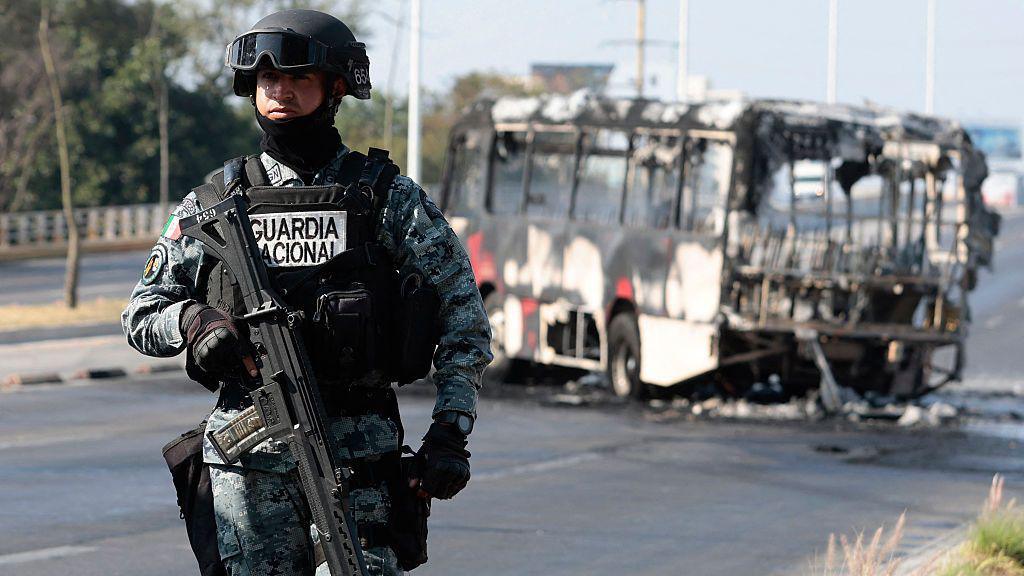
The Mexican government has ordered the massive deployment of thousands of military and National Guard personnel across several states, responding to a dangerous escalation of violence unleashed after the death of a major drug cartel kingpin. The measure, described by analysts as one of the largest containment operations in years, aims to restore order in regions where criminal groups have engaged in fierce battles for control of vacant territories, spreading terror among the civilian population. President Andrés Manuel López Obrador confirmed the mobilization during his morning press conference, emphasizing that the primary goal is "to protect Mexican families" and prevent cartels from exploiting the power vacuum.
The trigger for this crisis was the elimination, in a joint operation between federal forces and intelligence agencies, of a historic leader of one of Mexico's most powerful and bloodthirsty cartels. Although authorities have not fully disclosed the identity for operational security reasons, sources close to the investigation indicate it is a key figure in fentanyl trafficking to the United States and nationwide extortion networks. His death, far from pacifying the area, triggered an internal struggle for succession that quickly translated into highway blockades with burning vehicles, attacks on police stations, public executions, and daylight clashes in urban areas.
Preliminary data is alarming. According to reports from civil society organizations, in just 72 hours, more than 150 violent incidents linked to organized crime were recorded in the states of Sinaloa, Jalisco, Guanajuato, and Baja California, including at least 50 intentional homicides. Social media was flooded with videos showing heavily armed men patrolling streets and setting up illegal checkpoints, while businesses and schools remain closed for fear of reprisals. "It's a situation of absolute terror. People aren't leaving their homes, and those who do see how criminal groups act with total impunity," declared María González, director of the Citizen Security Observatory.
The military deployment, which according to estimates from the Secretary of National Defense involves over 5,000 soldiers and 2,000 National Guard members, is concentrated in strategic points such as logistical hubs, drug corridors, and cities where state presence had weakened. The forces have orders to establish a security cordon, dismantle blockades, and conduct intensive patrols. However, security experts warn this is a temporary solution. "Militarization can calm the surface, but it doesn't attack the roots of the problem: the fragmentation of cartels, local corruption, and the lack of economic opportunities that push young people into crime," explained analyst Carlos Hernández from the College of Mexico.
The impact on daily life is profound. Public transport is disrupted in several localities, the supply of food and medicine has been affected, and hundreds of families have begun forced displacement to other regions. The crisis also has economic repercussions, with multimillion-dollar losses for the commercial and tourism sectors. Internationally, the United States has expressed its "concern" over the instability and offered intelligence support, while reiterating its confidence in the Mexican government's ability to handle the situation.
The conclusion drawn by observers is that Mexico faces, once again, the dilemma of the "kingpin paradox": eliminating a criminal leader often generates more short-term violence than it aimed to eradicate. President López Obrador's "hugs, not bullets" strategy is now undergoing its toughest test, forcing a tactical shift towards the use of force. The success of this operation will not be measured solely by the restoration of public order in the coming weeks, but by the state's capacity to build, in the medium term, solid civilian institutions and comprehensive security strategies that prevent the cycle of violence from repeating with the death of the next kingpin.