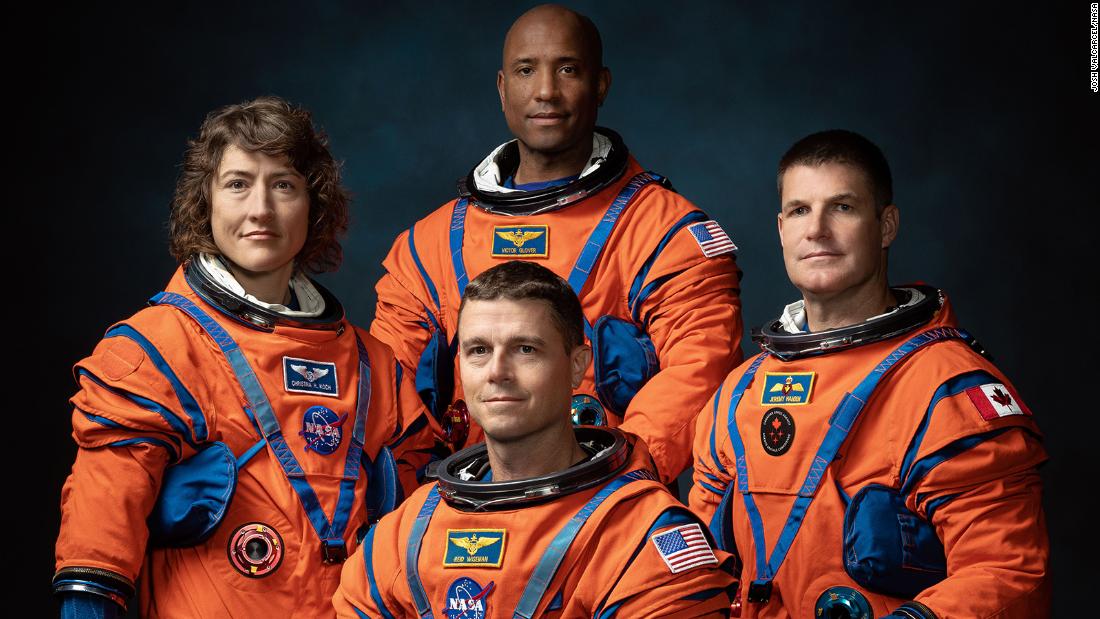
NASA has taken a monumental step toward returning humanity to the Moon by introducing the four astronauts who will crew the Artemis II mission, the first crewed lunar mission in over five decades. The announcement, made Monday during a ceremony at Johnson Space Center in Houston, Texas, marks the start of an intensive training phase for the historic lunar flyby scheduled for November 2024. The carefully selected crew represents a blend of experience and diversity, embodying the spirit of exploration for a new space age.
Artemis II is a crucial piece of NASA's Artemis program, whose ultimate goal is to establish a sustainable human presence on the Moon and pave the way for future missions to Mars. Unlike Artemis I, an uncrewed test flight successfully completed in December 2022, Artemis II will carry a human crew on a journey around the Moon and back to Earth, testing the Orion spacecraft's systems in a deep-space environment with people on board. This approximately 10-day flight will validate life support, navigation, and communication capabilities essential for the future landing mission, Artemis III.
The crew consists of three NASA astronauts and one from the Canadian Space Agency (CSA). Commanding the mission will be veteran Reid Wiseman, a U.S. Navy captain with a previous 165-day mission aboard the International Space Station (ISS). The pilot will be Christina Hammock Koch, who holds the record for the longest single spaceflight by a woman (328 days) and participated in the first all-female spacewalk. Mission specialist Victor Glover, a test pilot and ISS veteran, served as pilot on SpaceX's Crew Dragon first operational mission. Representing the CSA, mission specialist Jeremy Hansen, a former Canadian Armed Forces fighter pilot, will be making his first spaceflight, highlighting the international nature of the Artemis collaboration.
"This mission represents more than a trip to the Moon; it's a bridge to the future," stated NASA Administrator Bill Nelson during the reveal. "These four brave individuals are not only making history; they are inspiring a new generation of explorers, the 'Artemis Generation,' showing that deep space exploration is a global and diverse endeavor." Astronaut Jeremy Hansen expressed, "We are united by a common goal: to push the boundaries of what is possible. For Canada, it is a tremendous honor to contribute to this critical step."
The impact of this announcement transcends the technical. It symbolizes the rebirth of lunar ambition after the end of the Apollo program in 1972. The inclusion of a diverse crew sends a powerful message about accessibility and representation in space exploration. The Artemis program, named after Apollo's twin sister in Greek mythology, aims to land the first woman and the first person of color on the lunar surface. The crew's training, beginning immediately, will include simulations of every mission phase, training on the Orion capsule systems, emergency preparedness, and physical conditioning to withstand the G-forces of launch and re-entry.
In conclusion, the reveal of the Artemis II crew is a turning point in 21st-century space exploration. It not only reactivates the path to the Moon but redefines it with a modern, international, and inclusive perspective. The success of this mission will validate the infrastructure needed for long-duration missions and solidify global partnerships for deep space exploration. The eyes of the world will be on Wiseman, Koch, Glover, and Hansen, whose names will be etched in history as the pioneers who reopened the door to the Moon for all humankind.