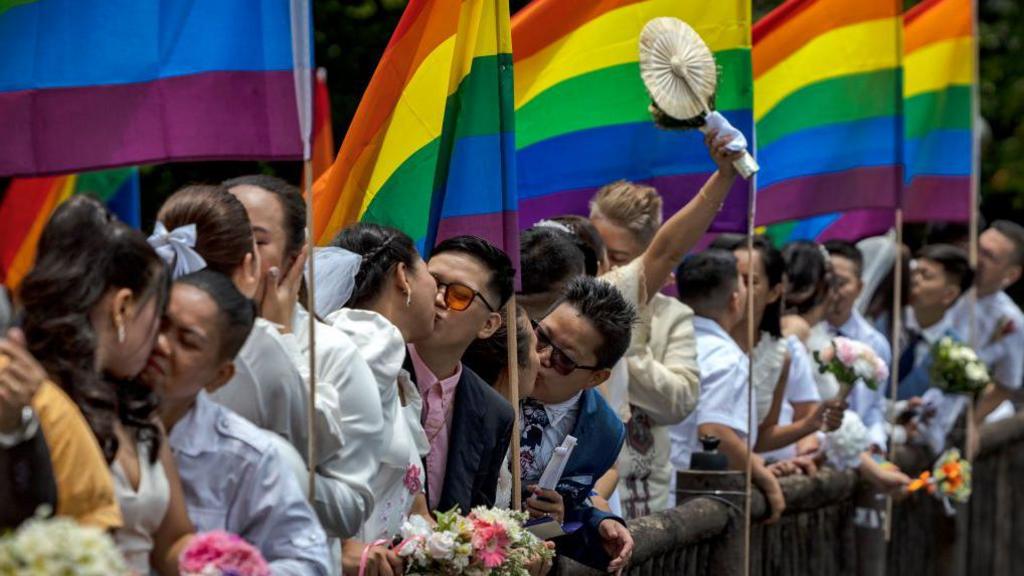
In a landmark decision marking a turning point for LGBTQ+ rights in the predominantly Catholic nation, the Philippine Supreme Court has ruled that same-sex couples have the right to co-own real property under joint ownership law. The ruling, issued on April 9, 2024, states that "legitimate intimate relationships" must not be "legally invisible," prying open a crucial legal door in a country where same-sex marriage remains unrecognized. The decision stems from a specific case where a female couple, identified as C.J. and A.L., sought to register a property acquired jointly during their relationship of over two decades, initially facing denial from the Register of Deeds due to the lack of an explicit legal framework.
The context of this ruling is fundamental to understanding its magnitude. The Philippines, with a population of over 110 million, is the only country in the world besides Vatican City where divorce remains illegal for the majority of its citizens, and the influence of the Roman Catholic Church, to which about 80% of the population belongs, is profound in the legislative and social sphere. Despite growing social acceptance and the existence of several local anti-discrimination ordinances, progress at the national level has been slow. The Philippine Family Code, enacted in 1987, defines marriage exclusively as a union between a man and a woman, leaving same-sex couples in a legal limbo regarding property rights, inheritance, adoption, and health benefits.
The Supreme Court's decision, penned by Associate Justice Henri Jean Paul Inting, is notable for its reasoning. The court applied by analogy the provisions of the Civil Code on co-ownership for unmarried couples (cohabitation), arguing that the "law must not close its eyes to the reality of same-sex relationships." The ruling underscores that denying these rights would constitute a violation of the constitutional guarantees of equal protection under the law and the right to private property. "The absence of a law that formally recognizes their union should not translate to a denial of their basic property rights arising from their de facto relationship, financial contribution, and mutual effort," part of the decision reads. This reasoning by analogy is seen by legal experts as a creative judicial tool to circumvent congressional inaction.
Reaction to the decision has been immediate and polarized. LGBTQ+ advocacy groups, such as Bahaghari and the Philippine LGBT Chamber of Commerce, have hailed the ruling as a "monumental victory" and a "crucial first step" toward broader legal recognition. "This validates the existence and contributions of Filipino LGBTQ+ families. We are no longer ghosts to the law when it comes to our homes," a Bahaghari spokesperson stated. Conversely, conservative groups and some church figures have expressed concern, arguing the decision undermines the traditional definition of family and could pave the way for same-sex marriage, which they strongly oppose. However, the court was careful to delimit the scope of its ruling, clarifying it does not legalize same-sex marriage or address other issues like adoption or automatic inheritance rights.
The practical impact of this ruling is significant. It allows same-sex couples to register properties under both their names under a co-ownership regime, providing a vital layer of legal security and financial protection. In the event of separation or the death of one partner, the other will now have a stronger legal basis to claim their share of the property. Specialized lawyers anticipate an increase in applications for joint property registration and the drafting of more detailed cohabitation agreements. Furthermore, it sets a powerful judicial precedent that can be invoked in future litigation over other rights stemming from de facto relationships, such as pensions, partner employment benefits, or hospital visitation rights.
In conclusion, the Philippine Supreme Court's decision represents a historic legal advance within a conservative social context. While it does not change the status of equal marriage, it breaks a critical barrier by acknowledging the legal reality of same-sex relationships in the property realm. The ruling exemplifies the judiciary's role in protecting minority rights when the legislative branch is reluctant to act. Although the path toward full legal equality in the Philippines remains long and likely fraught with intense debate, this decision is a beacon of progress that grants visibility, dignity, and tangible protection to thousands of Filipino couples who, until now, had been invisible in the eyes of the law.