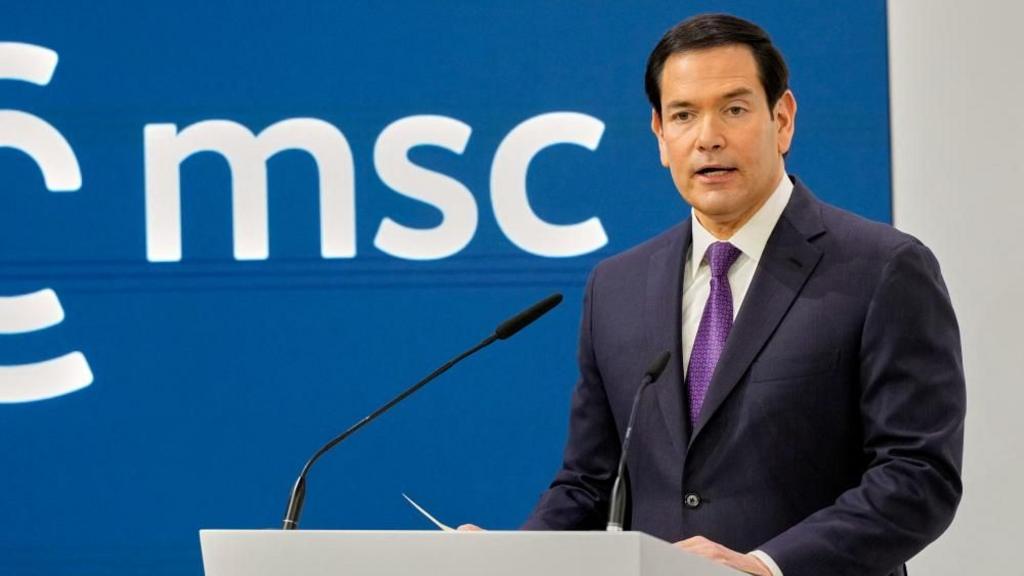
In a speech delivered at the Brussels Security Forum, U.S. Senator Marco Rubio (R-Florida) called for strengthening the transatlantic alliance, stating that the United States and Europe "belong together" despite the political and trade tensions that have marked the relationship in recent years. The message, aimed at an audience of political leaders, diplomats, and security experts, sought to emphasize the strategic importance of NATO and economic cooperation at a time of growing competition with China and Russia. Rubio, a member of the Senate Foreign Relations Committee and an influential voice on foreign policy within the Republican Party, stressed that disagreements over issues such as trade, defense, or climate change should not undermine the historical ties and shared values that bind both sides of the Atlantic.
The context for Rubio's remarks is complex. The relationship between the United States and the European Union has faced periods of significant friction, particularly during the Trump administration, which imposed tariffs on European steel and aluminum and openly questioned NATO's usefulness. Although Joe Biden's arrival at the White House in 2021 brought a more conciliatory tone and a renewed commitment to multilateralism, substantial disagreements persist. Issues such as technology regulation, subsidies for the green industry under the U.S. Inflation Reduction Act, and differing approaches to the conflict in Ukraine and the trade war with China continue to cause friction. Rubio acknowledged these challenges but argued they are "surmountable obstacles" within a partnership he considers fundamental to global stability.
Relevant data supports the interdependence Rubio seeks to preserve. The European Union and the United States constitute the world's largest bilateral economic relationship, with trade in goods and services exceeding one trillion dollars annually. Reciprocal direct investment is equally massive, supporting millions of jobs on both continents. In the security realm, NATO, with its 32 members following the recent accession of Finland and Sweden, remains the cornerstone of Western collective defense. Rubio specifically cited the unified response to Russia's invasion of Ukraine as a "testament to the power and resilience of our alliance," highlighting the coordinated delivery of military assistance and unprecedented economic sanctions.
In his remarks, Rubio was careful to balance the defense of unity with the defense of American interests. "Our economies are intertwined, our societies are connected, and our security is indivisible," the senator stated. "Yes, there will be disagreements. Yes, there will be economic competition. But at our core, we share a belief in human dignity, freedom, and the rule of law that sets us apart from our authoritarian adversaries." He also called on Europe to increase its defense spending more substantially and sustainably, a historical demand from Washington, and to adopt a firmer stance towards China, particularly regarding supply chain security and critical technology.
The impact of this speech is multifaceted. Domestically, it seeks to influence the debate within the Republican Party, where a more isolationist faction, led by figures like former President Donald Trump, has shown skepticism toward U.S. international commitments. By affirming the value of the transatlantic alliance, Rubio positions himself as a defender of traditional Republican internationalism. Internationally, the message is a reassurance for European allies, concerned that a change in the U.S. administration in the upcoming elections could lead to renewed distancing. The speech also sets a framework for future cooperation, suggesting that competition with China should be an area of collaboration, not division, between Washington and Brussels.
In conclusion, Marco Rubio's call for transatlantic unity reflects a deep understanding that the geopolitical challenges of the 21st century—from Russian aggression and China's rise to hybrid threats and economic security—require a coordinated response from Western democracies. While not minimizing existing tensions, his central argument is that shared interests and values are far more powerful than temporary differences. In an increasingly polarized world, the strength of the relationship between the United States and Europe is not a luxury but a strategic necessity. The success of this call to action will depend on both sides' ability to translate words into concrete policies that balance fair competition with essential cooperation, ensuring the alliance not only survives but thrives in the decades to come.