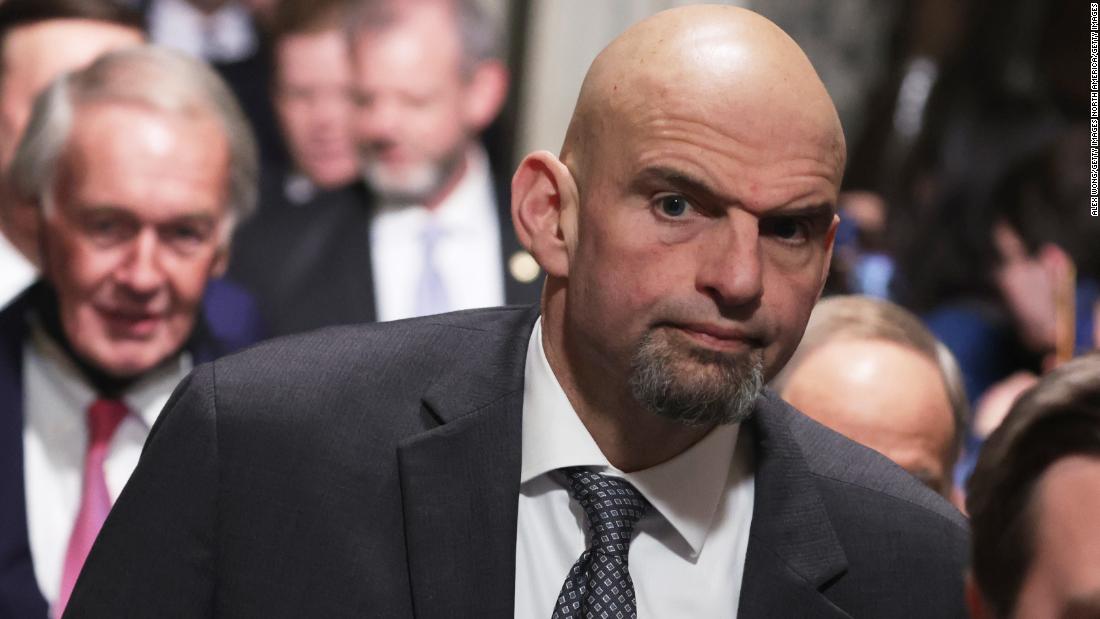
In a moving and unprecedented interview for a sitting United States Senator, Senator John Fetterman (D-PA) has spoken openly about his profound struggle with clinical depression, an episode that led him to seek inpatient treatment just weeks after his victory in the 2022 midterm elections. The revelation, made in an exclusive interview with CBS News, sheds light on the personal cost of an intense political campaign and the pressure of public office, while challenging the stigmas that still surround mental health, especially among men in positions of power.
The context of the senator's disclosure is crucial. Fetterman, then Pennsylvania's Lieutenant Governor, won one of the most closely watched and contentious national races, defeating celebrity television surgeon Mehmet Oz. The victory was celebrated as a key triumph for the Democratic Party, securing a crucial Senate seat. However, behind the public celebration, Fetterman was grappling with the aftermath of a stroke he suffered just before the Democratic primary in May 2022. The stroke impacted his auditory processing and language comprehension, conditions for which he now uses real-time transcription devices to perform his duties. The combination of physical recovery, adaptation to a new disability, and the immense pressure of transitioning to the federal Senate created a perfect storm for a mental health crisis.
In the interview, Fetterman candidly described his experience. "I had won the biggest election of my life," he stated, "and yet, at the end of the day, I didn't feel anything. I didn't feel joy, I didn't feel purpose. I just felt an overwhelming emptiness." He detailed how symptoms manifested soon after the electoral victory: social withdrawal, an inability to get out of bed, loss of interest in activities he once enjoyed, and persistently dark thoughts. He acknowledged that he initially resisted the idea of seeking help, a reflex, he said, of the "tough it out" culture often expected of politicians. It was his family and closest staff who ultimately urged, and supported, him to check into the Walter Reed National Military Medical Center in February 2023 for treatment for clinical depression.
Data on mental health in the political sphere is scarce, but experts note that high-pressure environments, constant public scrutiny, and the adversarial nature of modern politics are significant risk factors. Fetterman's decision to speak publicly follows in the footsteps of other leaders, like New Zealand Prime Minister Jacinda Ardern, who has spoken about burnout, but is particularly notable in the American context, where such disclosures have been historically rare. His experience also resonates with national statistics: according to the National Institute of Mental Health, an estimated 21 million adults in the U.S. experienced at least one major depressive episode in 2021.
The impact of his testimony is multifaceted. First, it deeply humanizes the figure of a senator, showing the vulnerability behind the office. Second, it serves as a powerful public health message, normalizing seeking treatment and demonstrating that depression can affect anyone, regardless of external success. "If someone like me, a United States Senator, can go through this and get help," Fetterman told CBS, "then maybe a dad in Pittsburgh, a student in Philadelphia, or a veteran in Scranton knows it's okay to ask for help, too." His statement has prompted a wave of bipartisan support and gratitude from mental health advocacy organizations, who praise his bravery and the potential of his story to save lives by reducing stigma.
In conclusion, Senator John Fetterman's revelation transcends mere political news. It is a significant cultural moment in the national conversation on mental health. By linking his crisis directly to the strains of an electoral campaign and the transition to power, it illuminates the unaccounted human costs of our political life. More importantly, by choosing transparency over secrecy, Fetterman uses his platform for a deeply personal and public purpose: to demonstrate that recovery is possible and that strength lies not in hiding pain, but in confronting it with help. His story is not just about a politician and his depression; it is an urgent reminder that mental well-being must be a priority, not a taboo, at all levels of society, including the halls of power.