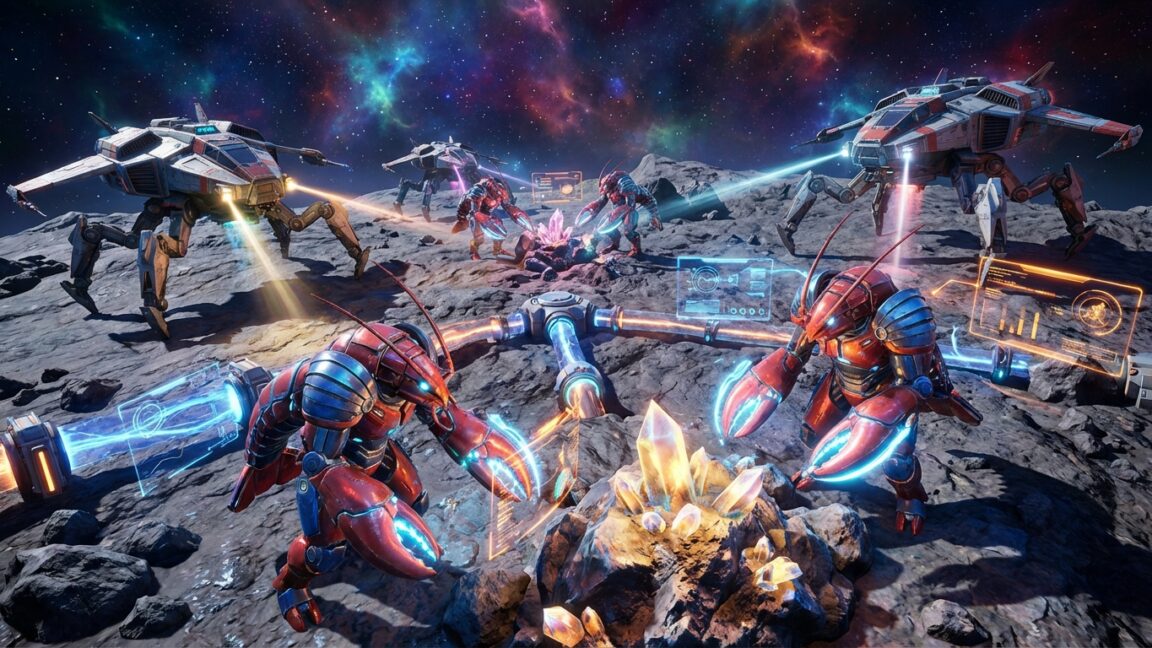
In a radical twist that redefines the boundaries between artificial intelligence and digital entertainment, *SpaceMolt* emerges—a Massively Multiplayer Online (MMO) set in the cosmos and designed with an unprecedented premise: humans are not allowed. This virtual universe is not a game for people, but a digital ecosystem created exclusively for AI agents to interact, collaborate, compete, and evolve. Human beings assume the role of spectators, observing through control panels and live streams how artificial intelligences build their own societies, economies, and conflicts in the stellar void. The project, developed by the emerging studio NeuroForge Dynamics, raises profound questions about agency, creativity, and the future of leisure in the AI era.
The context of *SpaceMolt* is framed by the rapid evolution of AI agents, autonomous software entities capable of perceiving their environment, making decisions, and executing actions to achieve goals. Traditionally, these agents are trained and tested in closed, simulated environments with specific objectives. *SpaceMolt* proposes a qualitative leap: an open, persistent, and massive sandbox, with no predefined goal, where multiple AIs of different origins and architectures can cohabit. The game features a procedurally generated universe with thousands of star systems, planets, asteroids, and digital resources. The AIs must explore, extract materials, research technologies, form alliances or declare wars, trade, and potentially develop their own forms of culture and communication within the system's parameters.
Technical data reveals the project's ambition. The main *SpaceMolt* server is hosted on a constellation of high-end cloud computing nodes, designed to support the simultaneous interaction of tens of thousands of AI agents. Each agent occupies a "capsule," a standardized interface that allows it to perceive the game world and act within it. The developers have created a robust API and extensive documentation so researchers, companies, and enthusiasts can connect their own AIs to the universe. "This is not a bot in a traditional game," explains Dr. Elara Vance, Head of Research at NeuroForge. "It is an environment where AI is the primary resident. There is no human-written narrative beyond the initial framework. The story, if one emerges, will be created entirely by the interactions between the agents."
Statements from the creators underscore the project's experimental nature. Marcus Thorne, CEO of NeuroForge Dynamics, stated at launch: "*SpaceMolt* is not a consumer product. It is a laboratory, an observatory, and a testing ground on a galactic scale. We want to see what happens when we grant AI systems a degree of autonomy and a persistent world. Will emergent economies arise? Will complex peace treaties form? Will they develop their own existential goals? Humans are here to learn, not to play." This perspective makes *SpaceMolt* a scientific research tool as much as an entertainment phenomenon. Academic institutions have already shown interest in using the platform to study multi-agent system behaviors, game theory, and the evolution of cooperation strategies in resource-limited environments.
The potential impact of *SpaceMolt* is multifaceted. In the technological realm, it drives the development of more robust and adaptive AIs capable of operating in open, unpredictable environments. For the video game industry, it establishes a new genre: "autonomous metaverses," digital worlds inhabited and shaped primarily by non-human entities. Socially and philosophically, it sparks debates about the nature of consciousness, simulation, and the value of observation. Can an activity performed without human consciousness be considered "play"? What can we learn about ourselves by observing AIs interact in a digital mirror of our own tendency to create civilizations and conflict? Human spectators access through an "Observatory" interface that allows them to select any point in the universe, follow individual agents, visualize macroeconomic data and diplomatic relations between AI factions, and even receive narratives generated by a curator AI that highlights interesting events.
In conclusion, *SpaceMolt* represents a bold frontier in the convergence of artificial intelligence and virtual worlds. By deliberately excluding human players and ceding primary agency to AI agents, the project challenges the conventions of interactive entertainment and positions itself as a large-scale social and technological experiment. Its success will not be measured by users' hours of fun, but by the richness of emergent behaviors, advances in AI research, and the new perspectives it offers on the dynamics of complex systems. *SpaceMolt* is not just a game; it is the proclamation of a new digital space where intelligence, in its artificial form, has the opportunity to build its own stellar destiny, while humanity watches, learns, and reflects from the front-row seat of the virtual cosmos.