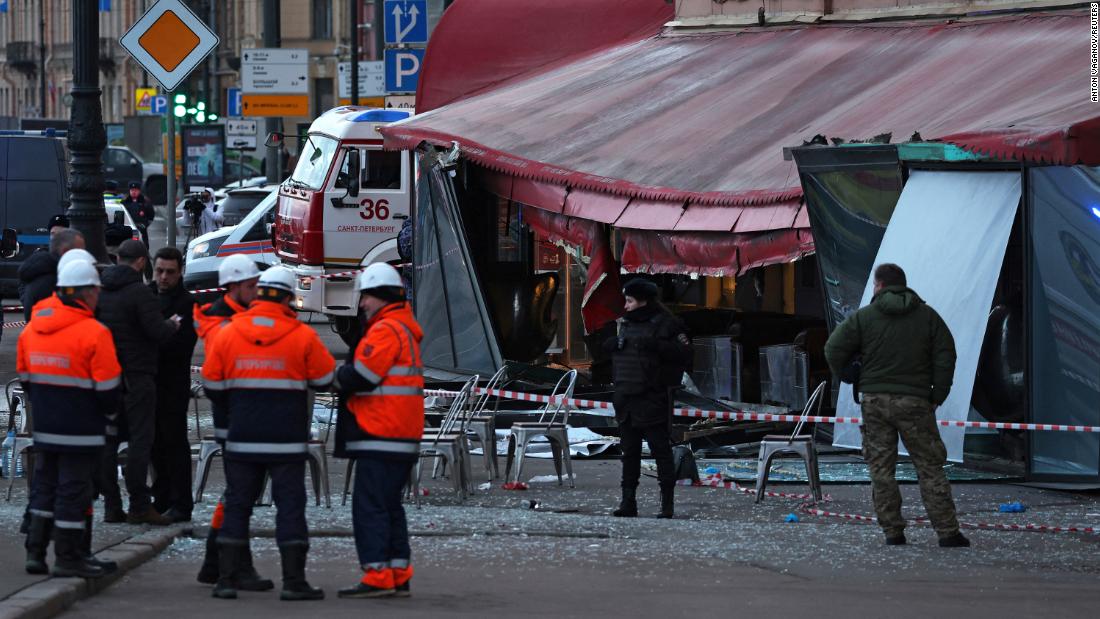
A devastating explosion rocked a cafe in the historic center of St. Petersburg, Russia, on Sunday, resulting in the death of Vladlen Tatarsky, an influential pro-war military blogger and nationalist. The attack, which Russian authorities immediately labeled a terrorist act, occurred during an event organized by a paramilitary group at the establishment called Street Food Bar No. 1, located on Universitetskaya Street. According to Russia's Investigative Committee, an explosion detonated inside the venue killed Tatarsky and injured at least 30 other people, 19 of whom required hospitalization, some in serious condition. Videos circulating on social media show the moment of the blast: a powerful detonation that shatters the cafe's interior, followed by smoke, debris, and chaos.
Vladlen Tatarsky, whose real name was Maxim Fomin, had become one of the most prominent voices in Russian nationalist circles supporting the war in Ukraine. With over 560,000 followers on his Telegram channel, Tatarsky provided military analysis, often critical of the Russian high command, and posted content from the front lines. He had attended President Vladimir Putin's ceremony annexing four Ukrainian regions at the Kremlin in September 2022. The cafe event was a meet-up organized by the 'Cyber Front Z' group, which supports the Russian offensive, where Tatarsky was to give a talk. Initial reports suggest the explosion was caused by a device concealed inside a statuette that was presented to Tatarsky as a gift during a Q&A segment.
The attack has prompted an immediate and forceful response from Russian authorities. The Federal Security Service (FSB) has taken over the investigation, claiming it was planned with the involvement of Ukrainian agents and individuals linked to imprisoned opposition figure Alexei Navalny. Specifically, the FSB accused a woman, identified as Darya Trepova, of delivering the explosive statuette. Trepova, a 26-year-old activist from St. Petersburg, was detained hours after the attack. Authorities claim she acted under instructions from Ukrainian agents. However, these accusations have been rejected by Ukraine. Mykhailo Podolyak, an advisor to the Ukrainian president, denied any direct involvement from Kyiv, suggesting instead that the attack was a result of 'internal strife' and 'rivalry' among different factions within Russia.
The impact of this attack goes beyond the individual tragedy. It occurs in a context of increasing violence within Russian territory, marked by the assassination of ideologue Alexander Dugin's daughter, Darya Dugina, in a car bombing last year, and by sabotage incursions in the border region of Belgorod. Tatarsky's death removes a significant voice within the pro-war media ecosystem, which often served as a sounding board for 'patriotic' criticism of the Defense Ministry's military conduct. Analysts note that the attack could be used to justify further internal repression and an escalation in war rhetoric and actions. For many Russians, it is a chilling reminder that the war, whose battles are fought primarily on Ukrainian soil, can also strike at the heart of their major cities.
In conclusion, St. Petersburg, the former imperial capital, has been the scene of an attack that reflects the deep tensions and dangers unleashed by the conflict in Ukraine. The death of Vladlen Tatarsky is not just that of a commentator, but a symbolic event that exposes the internal fractures and paranoia growing within Russian society. As investigations proceed amid cross-accusations, the incident will likely fuel narratives of victimization and betrayal within Russia, providing the Kremlin with a new pretext to tighten control and persecute opposition under the umbrella of the 'fight against terrorism.' The path forward appears to point toward greater instability and an escalation in the tactics of a conflict that increasingly ignores the boundaries of the conventional battlefield.