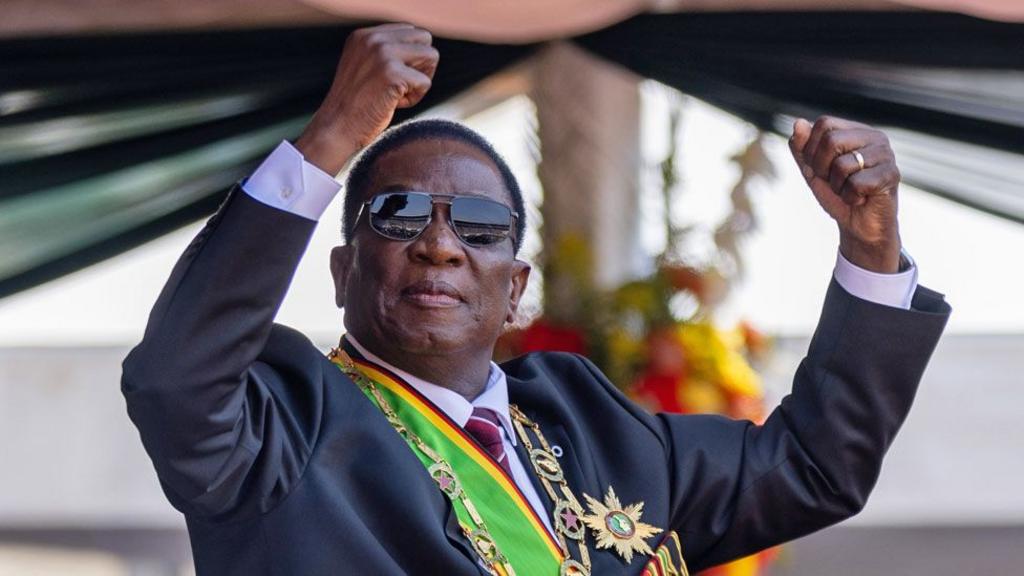
A controversial political bid has emerged in Zimbabwe, stirring the waters of an already complex landscape. A group of legislators and supporters from the ruling party, the Zimbabwe African National Union – Patriotic Front (ZANU-PF), has launched a formal initiative to amend the constitution and extend the term of President Emmerson Mnangagwa. The move, which seeks to align the length of the presidential term with the five-year parliamentary electoral cycle, could allow Mnangagwa to remain in power beyond his current constitutional limit, sparking intense debate about democracy and succession in the southern African nation.
The context of this initiative is crucial to understanding its significance. Emmerson Mnangagwa, 81, assumed the presidency in 2017 following a military coup that ousted the long-serving Robert Mugabe, who ruled for 37 years. Mnangagwa was subsequently elected in a controversial poll in 2018 and reelected in 2023 in electoral processes that international observers, including the European Union Election Observation Mission, deemed lacking in fairness and transparency. The current constitution, adopted in 2013, limits the president to two five-year terms. Mnangagwa is in his second and, theoretically, final term, which would expire in 2028. Proponents argue that the amendment seeks to "harmonize" electoral cycles and "guarantee stability," preventing presidential and parliamentary elections from being held in separate years, as is currently the case.
Relevant data paints a picture of a country still struggling to recover from decades of economic challenges and international isolation. Zimbabwe faces galloping inflation, which surpassed 47% year-on-year in early 2024, an extremely weak local currency, and external debt hovering around $14 billion. Unemployment is endemic, and millions of citizens rely on subsistence farming or have emigrated. In this scenario, the term extension proposal is seen by critics as a distraction from urgent economic problems and a setback for still-fragile democratic institutions. Proponents, however, point to figures on infrastructure projects, such as the expansion of the Kunzvi Dam to supply water to Harare, arguing that continuity is needed to complete these long-term plans.
Statements from involved parties have been forceful. "It is a matter of administrative efficiency and cost savings for the public treasury," declared a pro-government legislator who preferred anonymity. "Unifying electoral cycles will reduce political uncertainty and recurring campaign expenses." On the opposition side, Movement for Democratic Change (MDC) leader Nelson Chamisa has been categorical: "This is nothing more than a brazen attempt to perpetuate an individual in power. It is a slow constitutional coup. The people of Zimbabwe deserve free and fair elections, not tricks to prolong terms." Independent political analysts, such as Alexander Rusero from the University of Zimbabwe, warn: "This maneuver reflects the internal struggles within ZANU-PF and the lack of a clear succession mechanism. Instead of strengthening institutions, power is being personalized around Mnangagwa."
The impact of this proposal, if it advances, would be profound at the national and regional levels. Domestically, it could deepen political polarization and trigger protests in a country with a history of violent repression of dissent. It would also send a negative signal to international investors and credit institutions like the International Monetary Fund, with which Zimbabwe is trying to renegotiate its debt. Regionally, in a Southern Africa where neighboring countries like Zambia and Malawi have experienced peaceful transitions of power through the ballot box, a move to extend Mnangagwa's term could be seen as a step backward for democratic governance on the continent. The Southern African Development Community (SADC) and the African Union, which have mediated previous political crises in Zimbabwe, will likely monitor the situation closely.
In conclusion, the initiative to extend the presidential term in Zimbabwe is more than a mere technical electoral adjustment. It is a crucial test for the resilience of constitutional norms and democratic culture in a country with an authoritarian past. Its trajectory will reveal whether the mechanisms of power control, enshrined in the 2013 constitution, can withstand pressures from the ruling party. The ensuing debate, which will undoubtedly involve civil society, the media, and the international community, will largely define Zimbabwe's political future in the coming years, determining whether the country moves towards greater openness or consolidates a model of strong executive power with weakened temporal limits.