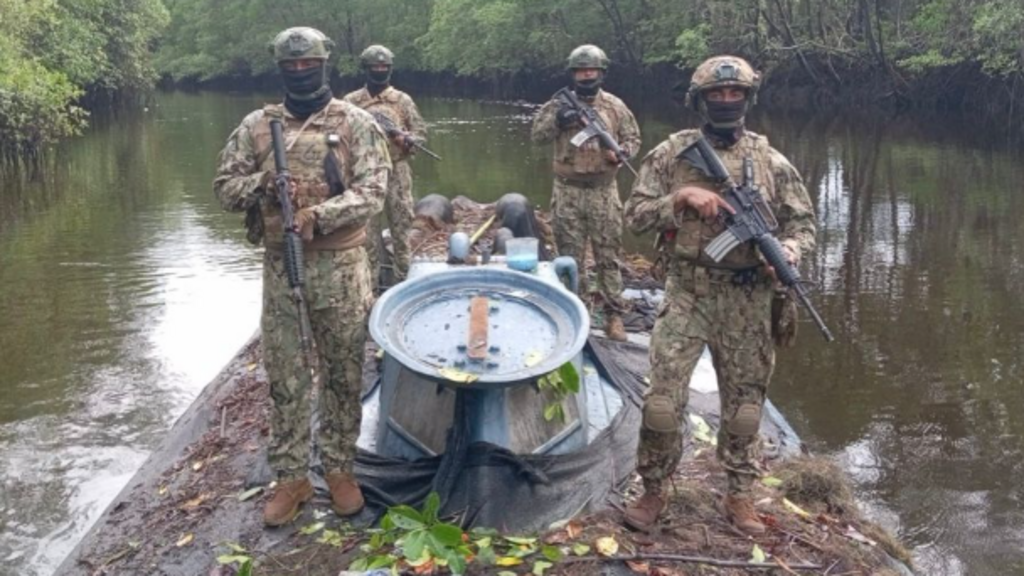
In a joint intelligence operation that underscores the growing sophistication of maritime drug trafficking, the Ecuadorian Armed Forces have seized a remarkable 35-meter-long semi-submersible submarine designed for the clandestine transport of narcotics. The discovery was made in a remote area of the Cayapas-Mataje Ecological Reserve, in the northwestern border province of Esmeraldas, a region of mangroves and intricate waterways that has become a strategic corridor for international organized crime. The vessel, colloquially known as a 'narco-sub' or 'low-profile vessel,' was located camouflaged among dense vegetation and prepared for launching, suggesting its construction was recently completed in this natural hideout.
This discovery is one of the most significant in the recent history of the anti-drug fight in the Southeast Pacific and highlights the industrial and logistical capacity of the cartels operating in the region. According to the official statement from the Ecuadorian Joint Command of the Armed Forces, the submarine, built primarily from fiberglass and wood, had the capacity to carry between 8 and 10 tons of cargo, presumably cocaine from Colombia destined for markets in North America or Europe. Its semi-submersible design, with only a small conning tower and hatches visible above the waterline, makes it extremely difficult to detect by radar and aerial patrols, representing a formidable challenge for maritime authorities.
Ecuador's Defense Minister, Gian Carlo Loffredo, highlighted the importance of the operation: 'This blow not only deprives criminal organizations of a high-value transport tool but also disrupts a complex logistical operation in one of our most sensitive natural areas.' The Cayapas-Mataje reserve, home to unique biodiversity and Awá indigenous communities, has seen an increased presence of illegal armed groups exploiting its labyrinthine geography for illicit activities. The construction of a vessel of this magnitude requires weeks of work, specialized materials, and a supply chain, indicating deep infiltration and possible local complicity.
Security experts consulted note that the find reflects an evolution in drug trafficking tactics. 'Narco-submarines have evolved from rudimentary boats to complex engineering projects,' explained Ana Rodríguez, an analyst at the Transnational Organized Crime Observatory. 'A 35-meter submarine, with a potential range of thousands of kilometers, represents a multi-million dollar investment and shows that cartels are operating with a quasi-corporate mindset, internalizing construction to reduce risks.' The seizure is part of a broader increase in violence and criminal power in Ecuador, a country that has become a critical transit point due to its geographical position between major producers and consumers.
The impact of this operation is multifaceted. On a security level, it temporarily weakens an export route and forces cartels to reconfigure their operations, although they likely have other vehicles in reserve. For Ecuador, it represents a tactical success amid a declared national security crisis, which has led the government to a state of exception and a militarized confrontation with narco-terrorist gangs. Environmentally, the news raises alarms about the use of protected areas as logistical bases for crime, with consequent ecological damage from deforestation, pollution, and alteration of fragile ecosystems.
In conclusion, the seizure of the narco-submarine in Esmeraldas is a stark reminder of the adaptability and limitless resources of international drug trafficking. While security forces celebrate a major blow, the underlying battle for territorial control, corruption, and the protection of communities and nature continues. This episode demands reinforced regional cooperation and comprehensive strategies that combine maritime interdiction with social development and environmental protection in the most vulnerable areas of the Pacific coast.