In the heart of Europe, a nation of just 5.4 million people has achieved an unprecedented industrial feat: becoming the world's largest car producer relative to the size of its population. Slovakia, a country that emerged from the dissolution of Czechoslovakia in 1993, has transformed its economy through a bold strategy of attracting foreign investment, positioning itself as Europe's premium car factory. With annual production exceeding one million vehicles, the automotive industry accounts for over 12% of the national GDP and directly employs tens of thousands of workers, crafting a success story that many developing countries observe with admiration.
The Slovak industrial miracle has its roots in the 1990s, when the government, led by economic reformers, decided to bet on advanced manufacturing as the pillar of its transition to a market economy. Its strategic geographic location in Central Europe, a skilled workforce with an engineering tradition, and generous tax incentives attracted the first major manufacturers. Volkswagen was the pioneer in 1991, establishing a plant in Bratislava that today produces iconic models like the Porsche Cayenne, Audi Q7, and Volkswagen Touareg. This initial success laid the groundwork for a robust supply chain and an industrial ecosystem that would soon catch the attention of other giants.
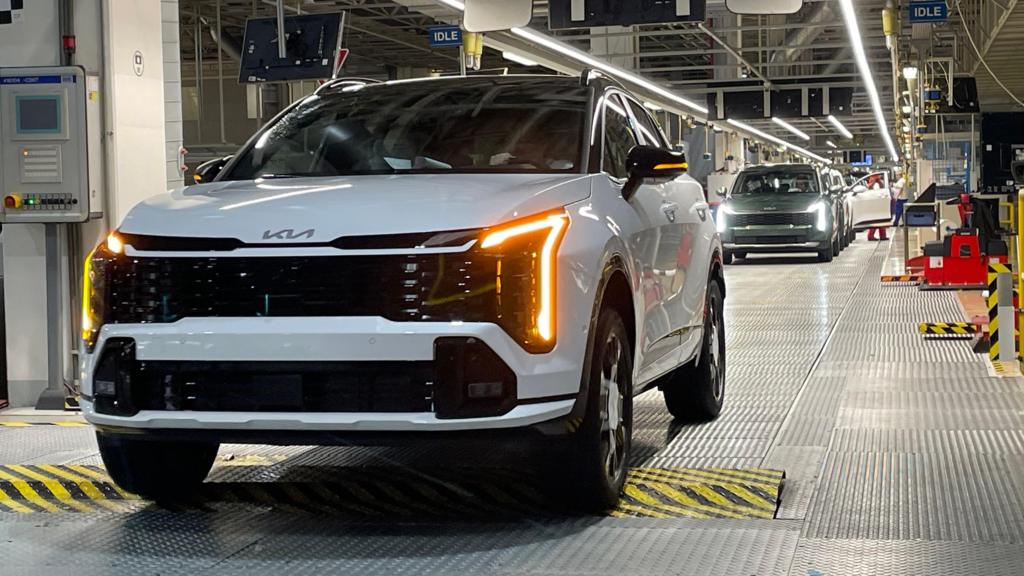
The arrival of PSA Group (now Stellantis) in Trnava in 2003 and Kia Motors in Žilina in 2004 consolidated the automotive cluster. More recently, Jaguar Land Rover opened a one-billion-euro plant in Nitra in 2018, specializing in the production of the Land Rover Defender. This concentration of four major manufacturers in such a small territory is unique globally. "Slovakia has shown that with a clear strategy, political stability, and a commitment to quality, you can compete on the world stage," stated Alexander Matušek, President of the Automotive Industry Association of Slovakia. "We are not the cheapest, but we offer value, innovation, and exceptional logistics," he added.
The data is eloquent: in 2023, Slovakia produced approximately 1.1 million vehicles. With a population of 5.4 million, this translates to over 200 cars manufactured per 1,000 inhabitants, a ratio that far surpasses traditional powers like Germany (approximately 130 per 1,000), Japan, or the United States. The industry accounts for over 40% of the country's total exports, with vehicles shipped to more than 100 markets. The transformation has been profound: cities like Žilina and Trnava, once industrial centers of the communist era, are now hubs of advanced technology with wages well above the national average.
However, this success comes with significant challenges. The Slovak economy exhibits high dependence on the automotive sector, making it vulnerable to fluctuations in global demand and supply chain disruptions, as evidenced during the pandemic and the semiconductor crisis. Furthermore, the transition towards electric mobility demands massive investments in plant retooling and workforce training. The government and companies are already acting: Volkswagen is transforming its Bratislava plant to produce electric platforms, and projects to manufacture lithium-ion batteries in the country are being developed.
The social and economic impact is undeniable. Wages in the Slovak manufacturing industry are among the highest in Eastern Europe, attracting talent and reducing emigration. However, the industrial concentration in the west of the country has exacerbated regional disparities, leaving the less developed east behind. Moreover, the pressure to increase productivity and automation raises questions about the future of mass employment in factories. Experts warn that the model must evolve towards greater local innovation, development of national suppliers, and diversification into high-tech sectors to ensure its long-term sustainability.
In conclusion, Slovakia's case is a fascinating study of how a small nation can redefine its economic destiny through smart industrial specialization and deep integration into global value chains. Its title of "world's largest car producer per capita" is not just a statistical fact, but a reflection of a structural transformation that has brought prosperity, but also new challenges. As the global automotive industry faces its greatest revolution in a century, Slovakia's ability to adapt and maintain its leadership will be the ultimate test of the resilience of its economic model. The path traveled offers valuable lessons for other countries aspiring to accelerated industrial development in a globalized and rapidly transforming technological world.